
RapidKit
Open-Source Workspace Intelligence for Software Systems



One workspace. One truth. Humans and AI aligned.
RapidKit turns scattered projects into a governed, agent-ready workspace.
It gives developers, CI, IDEs, and AI agents the same evidence-backed source of truth: workspace model, agent context, impact analysis, verification evidence, contracts, and release gates.
Start here
Install
npm install -g rapidkitCLI help
Browse all commands without a global install (first run fetches from npm):
npx rapidkit --helpCreate a governed workspace
npx rapidkit my-workspace --yes --profile polyglot
cd ~/rapidkit/workspaces/my-workspace

npx rapidkit bootstrap --profile polyglot
npx rapidkit create project nextjs my-web --yes
npx rapidkit create project fastapi.standard my-api --yes

npx rapidkit workspace model --json
npx rapidkit workspace context --for-agent --json --write
npx rapidkit pipeline --json --strict
Adopt an existing project
npx rapidkit adopt /path/to/project
cd ~/rapidkit/workspaces/workspai

npx rapidkit workspace model --json
npx rapidkit workspace context --for-agent --json --write
npx rapidkit pipeline --json --strict
What you get
- A governed workspace boundary for projects, policies, reports, and contracts
- Native create for RapidKit-owned backend and frontend kits
- Adopt/import for existing repositories without moving source code
- Agent-ready context packs for Copilot, Cursor, Claude, Codex, and other tools
- Impact analysis and release gates backed by workspace evidence
- One shared truth for developers, CI, IDEs, and AI agents
Create planner
RapidKit does not pretend every technology is a native scaffold. It uses a create planner contract to choose the safest path:
| Lane | Use when | Result |
|---|---|---|
native-create |
RapidKit owns the scaffold contract | Create the project with a first-class kit |
external-create-adopt |
The ecosystem has an official generator, but RapidKit does not own the post-create contract yet | Use the ecosystem generator, then adopt into Workspace Intelligence |
adopt-only |
The project already exists or native create is not supported | Register, model, verify, and govern the project without scaffolding it |
Native create includes FastAPI, NestJS, Go, Spring Boot, .NET, and official frontend generators such as Next.js, Vite, Nuxt, Angular, Astro, Remix, and SvelteKit.
External ecosystems such as WordPress, Laravel, Symfony, Rails, and generic PHP projects can still enter RapidKit through adopt/import and receive workspace model, context, impact, doctor, and release governance.
Details: docs/create-planner-capabilities.md.
Workspace Intelligence
Most AI tools understand:
- Files
- Functions
- Repositories
Production systems require understanding:
- Ownership
- Architecture
- Dependencies
- Operational context
- Verification requirements
- Change impact
RapidKit adds the missing layer:
Workspace Intelligence.
One workspace. One truth. Humans and AI aligned.
A shared, evidence-backed understanding of software systems for developers, CI pipelines, IDEs, and AI agents.
In RapidKit, Workspace Intelligence is not a chat feature. It is the deterministic workspace layer behind the CLI:
- Model — what projects, runtimes, frameworks, commands, policies, contracts, and evidence exist
- Context — what AI agents and IDEs should know before giving advice
- Impact — what changed and which projects, commands, and release gates are affected
- Verify — which evidence proves the workspace is ready, blocked, or needs attention
- Sync — how developers, CI, Workspai, and AI agents stay grounded in the same truth
From Code to Shared Understanding
How RapidKit transforms projects and repositories into workspace intelligence for developers, CI, and AI agents.
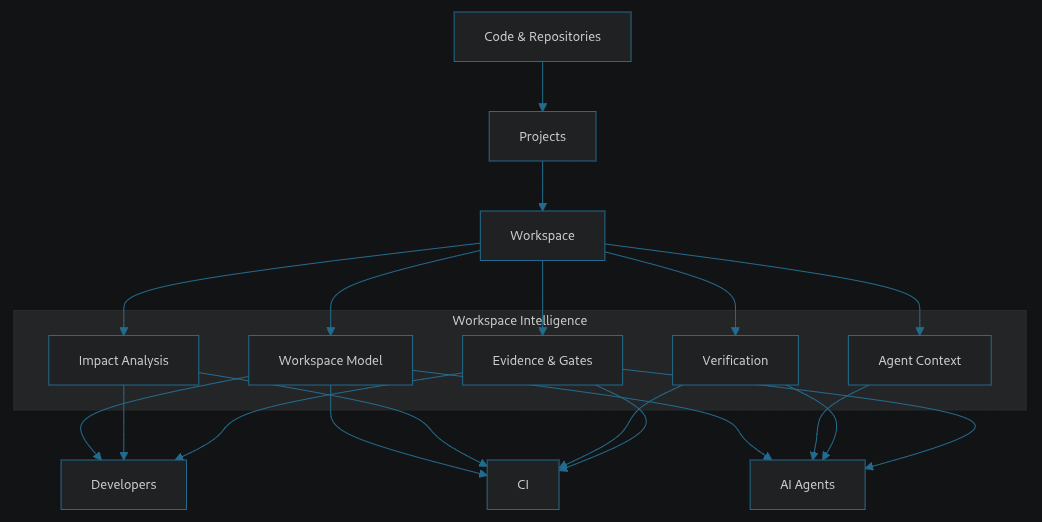
Mermaid source for GitHub docs: from-code-to-shared-understanding.md.
RapidKit provides the workspace intelligence engine: model, context, impact, verification, evidence, contracts, and governance.
Workspai provides the VS Code experience on top of that foundation.
For the visual experience, install the Workspai VS Code extension.
Table of contents
- Start here
- Create planner
- Workspace Intelligence
- From Code to Shared Understanding
- Typical workflows
- Mental model
- Workspace Intelligence Commands
- Agent Customization Pack
- Requirements
- Install
- Project workflows
- CI & evidence
- Workspai ecosystem
- VS Code extension
- Documentation
- Development
- Troubleshooting
- License
Typical workflows
| Question | Command |
|---|---|
| What projects exist in this workspace? | workspace model --json |
| What context should AI agents receive? | workspace context --for-agent --json --write |
| What breaks if I change this? | workspace impact --from <snapshot> |
| Why is release blocked? | workspace explain release-blocked --json --write |
| Trace a diff through blast radius and gates? | workspace trace --from .rapidkit/reports/workspace-model-diff-last-run.json --json --write |
| Can I safely release? | pipeline --json --strict |
| How do I align AI tools and CI? | workspace agent-sync --write |
| Expose workspace evidence to MCP clients? | workspace mcp serve |
| How do I onboard an existing project? | adopt |
| How do I bring repositories into a workspace? | import |
Existing project
npx rapidkit adopt /path/to/project --workspace /path/to/workspace
npx rapidkit workspace model --json
Agent-ready workspace
npx rapidkit workspace context --for-agent --json --write
npx rapidkit workspace agent-sync --write --refresh-context --preset enterprise
npx rapidkit workspace agent-sync --write --refresh-context --preset enterprise --experimental-hooks
Release verification
npx rapidkit pipeline --json --strictAdopt in place
npx rapidkit adopt /path/to/project --workspace /path/to/workspace --json
npx rapidkit adopt --json   # from inside the project folder
Workspace layout
~/.rapidkit/workspaces.json
~/rapidkit/workspaces/
  workspai/          # managed default (standalone, import, and adopt fallback)
  my-workspace/      # user-created workspaces
New workspaces go under ~/rapidkit/workspaces/<name>. Legacy ~/Workspai/rapidkits/* paths remain registered. Use --output <parent-dir> for a custom parent.
Mental model
Two-layer model
First-class engine kits  →  FastAPI and NestJS (modules + deep generation)
Workspace intelligence   →  frontend apps, Go, Spring, .NET, adopted/imported repos
RapidKit treats the workspace as the operating boundary: policy, registry, evidence, contracts, and release readiness. Projects can live inside the workspace or be adopted from outside.
workspace/
  .rapidkit/workspace.json
  .rapidkit/reports/
  services/api/

external-project/
  .rapidkit/project.json
  .rapidkit/adopt.json
Every tool gets the same answers: what projects exist, what stack they use, which commands are safe, what evidence exists, and what context agents should receive.
Workspace Intelligence Commands
Workspace Intelligence provides a shared understanding of projects, dependencies, operational context, and release readiness for developers, CI pipelines, and AI agents.
| Command | Purpose |
|---|---|
workspace model [--cache|--incremental] --json |
Canonical workspace model (graph-aware, incremental rebuilds) |
workspace context --for-agent --json --write |
Agent-ready context pack + auto agent grounding sync |
workspace agent-sync --write |
Agent Customization Pack (AGENTS.md, Copilot, Cursor, Claude, INDEX, skills, agents) |
workspace snapshot --json |
Persist model snapshot |
workspace diff --from <file|git[:ref]> --json |
Diff against snapshot or git |
workspace impact --from <file> --json |
Graph-aware transitive blast-radius evidence |
workspace verify [--strict] --json |
Definitive verification gate (subgraph + freshness + policy + fleet evidence) |
workspace explain <target> [--write] --json |
Human narrative for release blockers, projects, or trace slices |
workspace why <target> |
Alias of workspace explain |
workspace trace --from <diff> [--write] --json |
Diff → impact → gates narrative for agents and IDE handoff |
workspace feedback record --json |
Append structured agent action outcomes to intelligence history |
workspace mcp serve |
Read-mostly stdio MCP bridge over workspace evidence |
workspace graph <emit|explain|dot|mermaid> |
Inspect and visualize the dependency graph |
workspace watch [--json] [--once] |
Daemon mode: keep model + graph in memory, stream change events |
workspace run <stage> [--scope project:X] [--reuse-passed] |
Fleet init/test/build/start or custom stages from .rapidkit/context.json |
JSON schemas: contracts/workspace-intelligence/. Command coexistence and naming:
docs/contracts/NAMING_AND_COEXISTENCE.md.
Details: commands-reference.md.
Operational intelligence (Phase 4)
After model → diff → impact → verify, use explain and trace for human/agent narratives, feedback to record outcomes, and MCP serve for read-only tool access:
npx rapidkit workspace explain release-blocked --json --write
npx rapidkit workspace trace --from .rapidkit/reports/workspace-model-diff-last-run.json --json --write
npx rapidkit workspace feedback record --json
npx rapidkit workspace mcp serve
Fleet runs support scoped execution and result reuse:
npx rapidkit workspace run test --scope project:api --reuse-passed --json
npx rapidkit workspace run lint --scope project:api   # custom stage from context.json
Graph-aware intelligence engine
The workspace model carries a deterministic, first-class dependency graph that
impact, verify, and graph all reason over — so the same evidence drives blast
radius, gating, and visualization:
- Transitive blast radius —
workspace impactreports each affected project'sdistance,path, andviaedge back to the change, plus centrality-weighted critical-path hotspots. - Whole-subgraph gate —
workspace verifygates the changed projects and their transitive dependents, surfaces graph integrity issues (cycles, dangling edges, orphans), and emits a structuredgate(passed/mode/exitCode/reasons). - Transitive freshness — a deterministic
fresh | stale | unknownverdict chained through the graph: a dependency change makes every dependent stale, not just by timestamp. - Policy violations — model/contract violations are surfaced as structured
policyViolations[](not just an exit code) so IDEs and CI can render blockers. - Health history — every verify run appends to a bounded
.rapidkit/reports/workspace-intelligence-history.jsonring buffer for trends. - Fast rebuilds —
workspace model --cache/--incrementalreuse unchanged project models and re-infer only incident edges, keyed by a structuralinputsHash. - Watch / daemon —
workspace watchkeeps the model + graph in memory and streams deterministicworkspace-watch-event.v1change events (changed projects, graph edge deltas, structural hash) via fast incremental rebuilds.
Agent Customization Pack
RapidKit can generate a versioned Agent Customization Pack so AI tools do not start from an ungrounded repository scan. They start from the same workspace truth developers and CI use: reports, commands, contracts, blockers, scope, and verification evidence.
This is CLI-only and does not require the Workspai extension:
# Full enterprise pack:
# context pack + INDEX + AGENTS.md + Copilot/Cursor/Claude/Codex surfaces + MCP-ready design
npx rapidkit workspace agent-sync --write --refresh-context --preset enterprise

# Optional advisory VS Code agent hooks (disabled by default in the generated file)
npx rapidkit workspace agent-sync --write --refresh-context --preset enterprise --experimental-hooks

# Context pack write also syncs grounding by default
npx rapidkit workspace context --for-agent --json --write

# CI strict gate (fail if required reports missing/stale)
npx rapidkit workspace agent-sync --write --strict --json

# CI drift gate after sync
npm run check:agent-customization-drift -- --workspace <workspace-root>| Artifact / file | Purpose |
|---|---|
.rapidkit/reports/agent-customization-pack.json |
Versioned output inventory, target matrix, drift state |
.rapidkit/reports/workspace-explain-last-run.json |
Unified explain / trace narrative for blockers and projects |
.rapidkit/reports/workspace-skills-index.json |
Index of operational playbooks (.rapidkit/skills/*.md) |
.rapidkit/skills/rapidkit-*.md |
Operational playbooks (generated by agent-sync) |
.rapidkit/reports/rapidkit-mcp-design.json |
Read-mostly MCP-ready tool design manifest |
.rapidkit/reports/INDEX.json |
Read order, blockers, report timestamps |
.rapidkit/reports/workspace-context-agent.json |
Canonical agent context pack |
.rapidkit/AGENT-GROUNDING.md |
Tool-agnostic grounding doc |
AGENTS.md |
Open standard for all agents (managed RapidKit section) |
.github/copilot-instructions.md |
GitHub Copilot / VS Code Chat always-on rules |
.github/instructions/rapidkit-workspace.instructions.md |
Copilot workspace scope and command discipline |
.github/instructions/rapidkit-evidence.instructions.md |
Copilot scoped rules for .rapidkit/** |
.github/prompts/rapidkit-diagnose.prompt.md |
Copilot reusable diagnose prompt |
.github/skills/rapidkit-workspace-intelligence/SKILL.md |
Workspace Intelligence skill workflow |
.github/skills/rapidkit-workspace-intelligence/resources/mcp-tools.md |
Future MCP tool design reference |
.github/agents/workspai-advisor.agent.md |
Read-only workspace advisor agent |
.github/agents/workspai-repair.agent.md |
Blocker repair agent |
.github/agents/workspai-release.agent.md |
Release safety agent |
.github/agents/workspai-project-onboarder.agent.md |
Project onboarding agent |
.cursor/rules/rapidkit-grounding.mdc |
Cursor always-on project rule |
CLAUDE.md |
Claude Code entry (@AGENTS.md + managed notes) |
.claude/rules/rapidkit-evidence.md |
Claude Code scoped evidence rules |
.vscode/rapidkit-agent-hooks.json |
Optional advisory VS Code hooks (--experimental-hooks) |
The pack also publishes a standard answer contract for agent-facing output:
Scope -> Evidence -> Diagnosis -> Fix Plan -> Run -> Verify -> AssumptionsThat contract is what keeps agent responses operational: every recommendation should name the workspace/project scope, cite the evidence it used, explain the diagnosis, propose the command or file action, and tell the user how to verify the result.
Agents cannot be forced probabilistically. This stack makes the desired behavior explicit, versioned, and easy for IDEs, CI, and Workspai to audit.
Skip auto-sync after context write: --no-agent-sync. Target specific ecosystems: --target copilot,cursor,claude.
After pipeline, grounding syncs automatically (refresh context + INDEX + agent surfaces). Disable with --no-agent-sync or RAPIDKIT_NO_AGENT_SYNC=1.
Contract: contracts/agent-customization-pack.v1.json. Artifact map:
docs/contracts/ARTIFACT_CATALOG.md.
CI template: docs/examples/ci-agent-grounding.yml.
Requirements
- Node.js
>= 20.19.6 - Python
>= 3.10(for Python/Core workflows) - Java 21+, Go, .NET SDK 8+ (optional, per stack)
Install
npm install -g rapidkitProject workflows
I already have a project
npx rapidkit adopt /path/to/project
npx rapidkit import ../orders-api
cd ~/rapidkit/workspaces/workspai

npx rapidkit workspace model --json
npx rapidkit doctor workspace --json
I want a new project
npx rapidkit my-workspace --yes --profile polyglot
cd ~/rapidkit/workspaces/my-workspace

npx rapidkit bootstrap --profile polyglot
npx rapidkit create project          # interactive kit picker
npx rapidkit create project nextjs my-web --yes
npx rapidkit create project fastapi.standard my-api --yes
cd <project-name> && npx rapidkit init && npx rapidkit dev
Backend kits: fastapi.standard, nestjs.standard, springboot.standard, gofiber.standard, dotnet.webapi.clean, and more.
Frontend kits: nextjs, remix, vite-react, nuxt, angular, astro, sveltekit, and more — same command shape:
npx rapidkit create project <kit> <name>(create frontend <id> remains supported as an alias.)
Shortcut: npx rapidkit platform (interactive workspace wizard).
I want CI or release gates
npx rapidkit pipeline --json --strictStages individually: workspace sync, doctor workspace --ci, analyze --strict, readiness --strict, autopilot release.
CI & evidence
| Stage | Report |
|---|---|
| Pipeline | .rapidkit/reports/pipeline-last-run.json |
| Doctor | .rapidkit/reports/doctor-last-run.json |
| Analyze | .rapidkit/reports/analyze-last-run.json |
| Readiness | .rapidkit/reports/release-readiness-last-run.json |
| Autopilot | .rapidkit/reports/autopilot-release-last-run.json |
Common workspace commands:
npx rapidkit doctor workspace
npx rapidkit workspace agent-sync --write --refresh-context
npx rapidkit setup <python|node|go|java|dotnet> [--warm-deps]
npx rapidkit workspace list
npx rapidkit cache <status|clear|prune|repair>
npx rapidkit mirror <status|sync|verify|rotate>
Full syntax: docs/commands-reference.md. CI workflows: docs/ci-workflows.md — includes .github/workflows/ci.yml, .github/workflows/workspace-e2e-matrix.yml, .github/workflows/windows-bridge-e2e.yml, .github/workflows/e2e-smoke.yml, .github/workflows/security.yml.
Workspai ecosystem
RapidKit and Workspai form a single workspace intelligence platform.
RapidKit provides the workspace intelligence engine: model, context, impact, verification, evidence, contracts, and governance.
Workspai — Workspace + Intelligence — provides the VS Code surface: dashboard, sidebar, Incident Studio, AI workflows, and developer-facing workspace operations.
| Component | Repository | Role |
|---|---|---|
| CLI | rapidkit-npm | Commands, governance, adoption, CI evidence |
| VS Code | rapidkit-vscode | Workspai dashboard, sidebar, AI studio |
| Core | rapidkit-core | Python engine, modules, doctor |
| Examples | rapidkit-examples | Starter workspaces |
VS Code extension
Workspai is the VS Code experience for RapidKit workspace intelligence.
Search Workspai in the marketplace or install via:
ext install rapidkit.rapidkit-vscode.
| Feature | CLI | Extension |
|---|---|---|
| Create / adopt / import | Yes | Guided wizards |
| Workspace model / context | Yes | Dashboard + AI scope |
| Cross-tool agent grounding | Yes (workspace agent-sync) |
Send-to-Copilot / Ask Studio UX |
| Enterprise evidence loop | Partial | Full dashboard |
| Module catalog (FastAPI/NestJS) | Limited | Browser UI |
The extension invokes this npm CLI. For the latest adopt and frontend generator features, install matching CLI version: npm install -g rapidkit@latest or npm link from this repo (Development).
Documentation
| Doc | Description |
|---|---|
| docs/README.md | Documentation index |
| docs/commands-reference.md | Full command syntax |
| docs/workspace-operations.md | Import, adopt, snapshots, archives, infra |
| docs/workspace-run.md | Polyglot fleet orchestration |
| docs/doctor-command.md | Doctor scopes, CI exit codes, JSON evidence |
| docs/OPEN_SOURCE_USER_SCENARIOS.md | Role-based workflows |
| docs/SETUP.md | Maintainer setup |
| docs/SECURITY.md | Security policy |
| docs/config-file-guide.md | User configuration |
| CHANGELOG.md | Version history |
Development
npm ci && npm run build && npm run test
npm run install:local   # link CLI globally for manual testing
Contributors: docs/DEVELOPMENT.md, docs/ci-workflows.md.
npm run prepack validates embeddings and CLI surfaces before npm pack / npm publish.
Troubleshooting
| Problem | Quick check | Fix |
|---|---|---|
python3 not found |
python3 --version |
Install Python 3.10+ |
setup --warm-deps skipped |
Project markers in cwd | Run from target project directory |
| Strict policy blocks command | .rapidkit/policies.yml |
workspace policy set … |
npm audit fix --force downgrades tsup |
package.json |
Do not use --force; keep tsup@^8.5.1 |
| Security audit fails on esbuild | npm audit --audit-level=moderate |
Keep esbuild override in package.json |
| Doctor output stale | Report timestamps | Re-run doctor workspace or doctor project |
| Copilot ignores workspace evidence | Missing grounding files | workspace agent-sync --write --refresh-context |
| Agent grounding strict CI failed | Stale/missing reports | Run governance chain then re-sync |
| Affected run scope wrong | Git ref | Use --since <ref> explicitly |
License
MIT — see LICENSE.