

nark
Profile coverage scanner for npm packages — find missing error handling before production.
nark scans your TypeScript codebase against a curated library of 169+ package profiles to find places where error handling is missing. Think of it as a linter, but for runtime failure modes — unhandled promise rejections, missing .on('error') listeners, uncaught API exceptions.



Verify this yourself
We try to replace "trust me" with "here, verify." Every claim below points at something you can re-check on your own machine or from a third-party page we do not control:
- Source you can read. Repo at https://github.com/nark-sh/nark — AGPL-3.0, no closed-source binary.
- Provenance attestation. Published with
npm publish --provenancevia npm Trusted Publishing. The green Provenance badge on the npm page cryptographically links the published tarball to the exact git commit and CI run. Verify any installed copy withnpm audit signatures. - Third-party supply-chain score. Continuously scored by Socket. We don't submit anything — Socket scans every published version automatically.
- Third-party project-health score. OpenSSF Scorecard re-runs weekly against the public repo. Anyone can re-derive the score from scratch.
- Score history. Daily-updated Socket score timeline at https://nark.sh/status — every entry is committed to a public workflow log.
- What ships in the tarball. Run
npm pack --dry-run nark— you'll see onlybin/,dist/,schema/,demo/,FORAIAGENTS.md. Nothing else. - No install scripts.
npm install nark --ignore-scriptsproduces an identical install. nark runs zero code on your machine at install time. - Telemetry, in full detail. Schema, endpoint, and the three opt-out paths documented at https://nark.sh/telemetry. See Telemetry below.
- Responsible disclosure. SECURITY.md — 48h acknowledgement, security@nark.sh.
Honest about false positives
Nark uses static analysis. Static analysis is an approximation — the scanner reasons about code without running it, so some flagged violations may be false positives if your project handles errors at a layer Nark cannot see yet: a central Express or NestJS error middleware, a React error boundary, a retry wrapper one frame up, a try-catch in the calling function, or a library that catches internally.
What we do to keep the rate honest:
- Profiles are evidence-based. Every postcondition cites the package's documentation or source code. We do not invent rules.
- The scanner recognizes common framework patterns. It understands TanStack
Query global handlers, TanStack Router loader callbacks, tRPC callback wrappers,
Fastify
setErrorHandler, Express and Koa error middleware, NestJS exception filters, and several other architectural patterns. The list grows monthly. - We measure before we ship. Every scanner upgrade is verified against real codebases before release.
If you see a false positive: suppress with // nark-ignore: <postcondition-id> next
to the line, or open an issue at
github.com/nark-sh/nark/issues with the
file:line — we update the Profile or scanner from real reports. We do not claim
the scanner is perfect. We claim it is honest about what it knows and what it does
not.
Quick Start
Try it in 60 seconds (no setup)
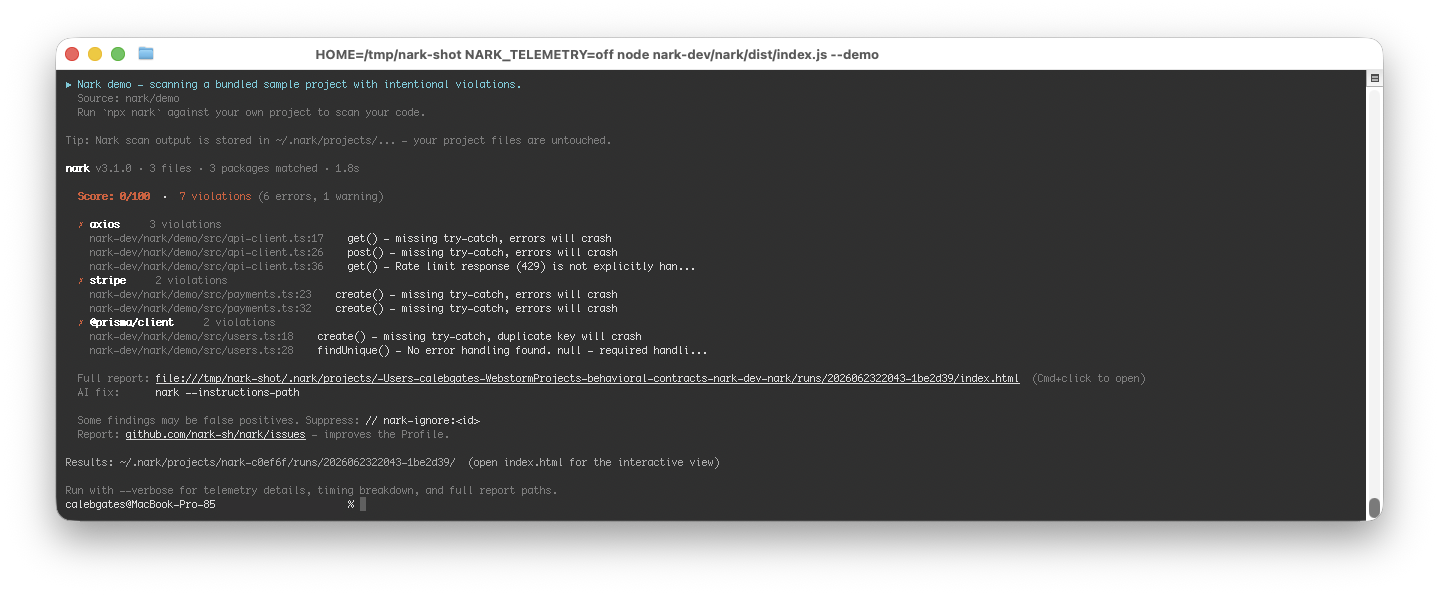
npx nark --demoThis runs Nark against a bundled sample project with intentional axios, stripe, and @prisma/client violations. The output is exactly what a real scan against your own code looks like — just with a guaranteed non-empty report.
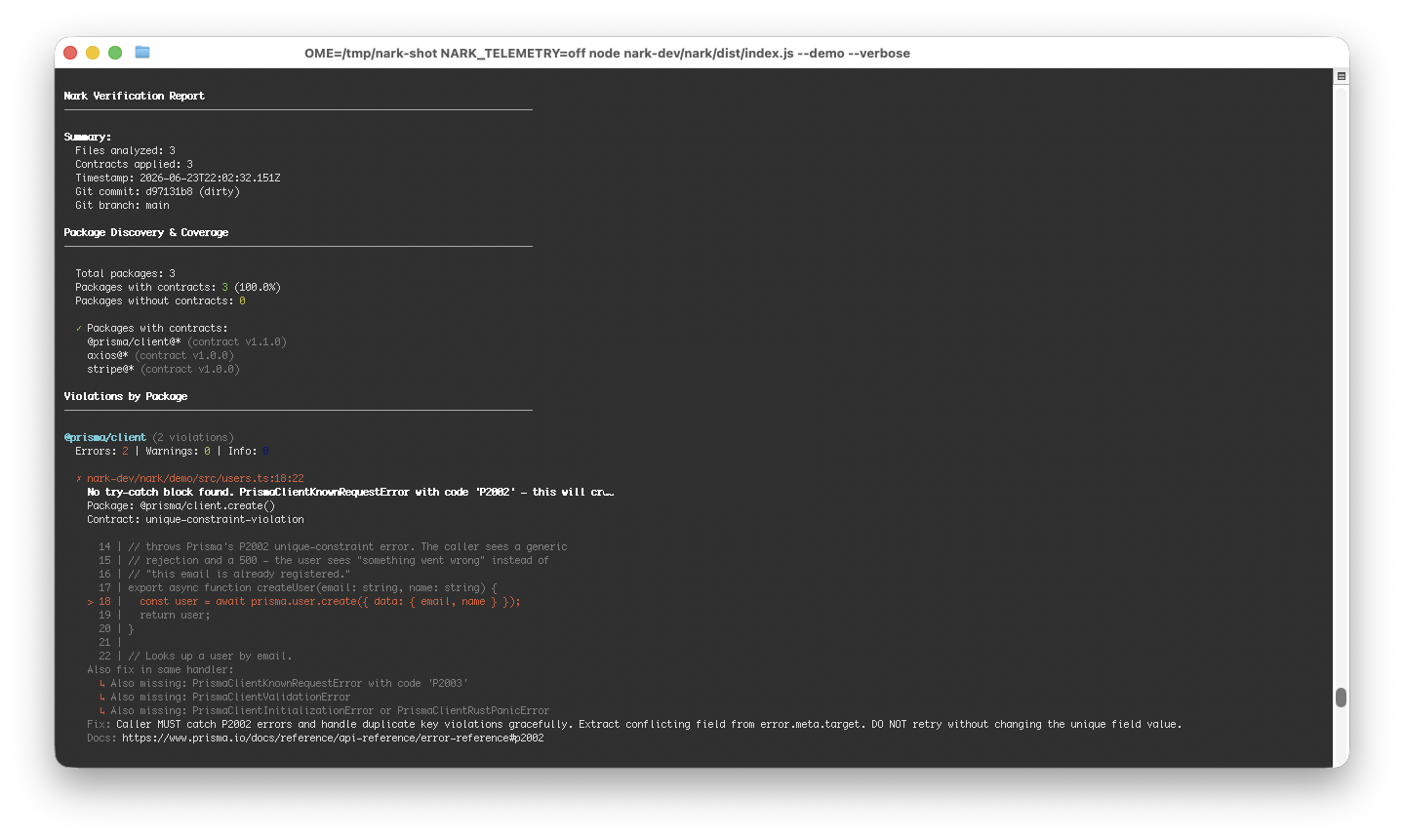
Run with --verbose to see the full Verification Report with code snippets and per-violation fix guidance:
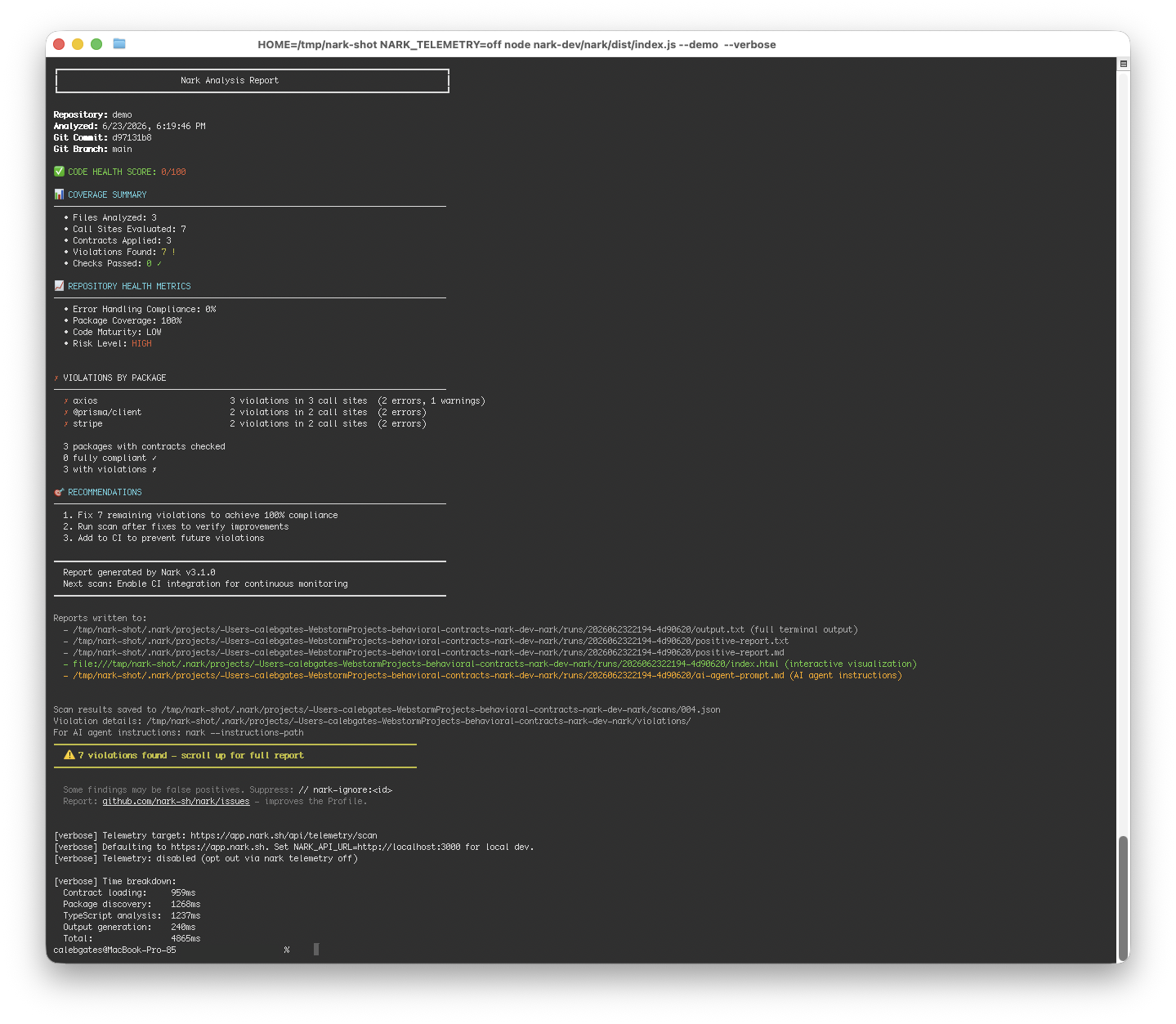
The verbose Analysis Report summarizes coverage, health metrics, and recommendations:
Or build from source
# Clone nark and the contract corpus side by side
git clone https://github.com/nark-sh/nark.git
git clone https://github.com/nark-sh/nark-corpus.git

# Build
cd nark
npm install
npm run build

# Verify it works by scanning nark itself
node bin/nark.js --tsconfig ./tsconfig.json --corpus ../nark-corpus

# Then scan your own project
node bin/nark.js --tsconfig /path/to/your/project/tsconfig.json --corpus ../nark-corpus
Scanning nark's own repo is a good smoke test — you should see a clean report with 0 violations and a handful of contracted packages detected.
If your project doesn't have a tsconfig.json, nark will generate a minimal one automatically.
If nark-corpus is installed as an npm package, nark finds it automatically — no --corpus flag needed.
Add to Your Project
Install nark as a dev dependency so your whole team runs it:
npm install --save-dev nark
# or
pnpm add -D nark
Add a script to your package.json:
{
  "scripts": {
    "nark": "nark"
  }
}
Then scan with:
npm run nark
# or just
pnpm nark
For CI, fail the build on violations:
pnpm nark --fail-threshold warningWhat It Finds
nark knows how 169+ npm packages fail at runtime. For each one, it checks that your code handles those failures. Example violations:
ERROR  axios.get() call without try-catch
  → src/api/client.ts:42
  Contract: axios → postcondition "network-error-handling"
  Fix: Wrap in try-catch and handle AxiosError

WARN   redis.connect() without .on('error') listener
  → src/cache/redis.ts:18
  Contract: ioredis → postcondition "connection-error-listener"
  Fix: Register error listener before calling connect()
How It Works
- Contracts define how packages fail (what errors they throw, what events they emit)
- Scanner walks your TypeScript AST and finds calls to contracted packages
- Analyzer checks if each call site has appropriate error handling
- Reporter outputs violations with severity, location, and fix suggestions
Contracts are YAML files in the nark-corpus package. The scanner uses TypeScript's compiler API — no runtime execution.
Output
Results go to .nark/ in your project directory:
.nark/
├── config.yaml              # Scanner configuration
├── latest -> scans/002/     # Symlink to most recent scan
├── scans/
│   ├── 001/
│   │   ├── summary.json     # Machine-readable results
│   │   └── summary.md       # Human-readable report
│   └── 002/
│       ├── summary.json
│       └── summary.md
└── violations/
    ├── axios/
    │   └── network-error-handling.md
    └── ioredis/
        └── connection-error-listener.md
Commands
Scan (default)
# Scan current directory
nark

# Scan a specific project
nark --tsconfig ./tsconfig.json

# Include test files
nark --include-tests

# Fail CI on warnings
nark --fail-on-warnings

# Report-only mode (always exit 0 — never block CI)
nark --report-only

# Exit 1 if any warnings or errors found
nark --fail-threshold warning

# SARIF output for GitHub Code Scanning
nark --sarif
nark --sarif-output results.sarif

# Compact summary output (full report is default)
nark --quiet
Show
Inspect nark's configuration and supported packages:
# Print nark version, Node version, corpus path, contract count
nark show version

# List all contracted packages (human-readable)
nark show supported-packages

# List as JSON
nark show supported-packages --json

# Show current auth/API endpoint config
nark show deployment
Telemetry
nark collects anonymous usage data to help prioritize development. Telemetry is enabled by default and can be disabled at any time. A notice is shown on first run.
Optional: hosted dashboard at app.nark.sh
If telemetry is on and you've run nark login, your scans show up in
a hosted dashboard at app.nark.sh with trend
lines, per-package rollups, and PR-level diff views. The dashboard is
entirely optional — nark runs the same scans locally either way, and
all results are always written to .nark/ in your project. The
dashboard is sugar on top, not a dependency.

What is collected: nark version, OS/arch, Node.js version, npm package names detected (public package names only), contract IDs matched, violation counts per contract, scan duration, CI mode flag, and an optional SHA256 hash of your git remote URL.
What is never collected: source code, file paths, variable names, directory names, repository names, git history, user identity, machine hostname, or IP addresses (stripped server-side).
# Check telemetry status
nark telemetry status

# Opt out permanently
nark telemetry off

# Opt out via environment variable (ideal for CI)
export NARK_TELEMETRY=off

# Respect the standard DO_NOT_TRACK convention
export DO_NOT_TRACK=1

# Opt back in
nark telemetry on
You can also set telemetry: false in .nark/config.yaml or point telemetry to a different endpoint with NARK_API_URL.
If telemetry posts time out (slow network, cold dev server), bump the timeout per-scan: nark --telemetry-timeout=10000 (ms; default 5000). Scan results are saved locally regardless of whether telemetry succeeds.
Learn more: https://nark.sh/telemetry
Crash reporting
nark sends anonymous crash reports to Sentry when it encounters an unexpected error. This helps catch bugs that affect real users. No source code, file paths, or identifying information is included (paths are scrubbed via beforeSend). Only 25% of errors are sampled to minimize overhead.
Crash reporting respects the same opt-out flags as telemetry, plus a dedicated kill switch:
# Disable only crash reporting (scan telemetry still flows)
export NARK_SENTRY=off

# Disable everything (telemetry + crash reporting)
export NARK_TELEMETRY=off

# Respect the standard DO_NOT_TRACK convention
export DO_NOT_TRACK=1
Authentication
Nark supports logging in to multiple workspaces (organizations) from the
same machine. Credentials live in ~/.nark/credentials.json, keyed by
organization slug, with file permissions 0600.
# Log in (browser-based device flow; pick the org from the dropdown)
nark login

# Pre-select an organization in the browser
nark login --org acme

# Show the active workspace + how it was resolved
nark whoami

# List all logged-in workspaces (marks default + most-recent)
nark workspace

# Switch the global default workspace
nark workspace use acme

# Bind THIS repo to a workspace (writes .nark/config.json — commit this!)
nark workspace use --here acme

# Locally rename a workspace alias
nark workspace rename old-slug new-slug

# Log out of the default workspace (auto-promotes next-most-recent)
nark logout

# Log out of a specific workspace
nark logout --org acme

# Log out of all workspaces (deletes ~/.nark/credentials.json)
nark logout --all
Multi-workspace flow
If you belong to more than one organization (e.g. a personal org + a team org), log in to each:
nark login --org personal
nark login --org acme
The first login becomes your default. Subsequent logins do not change the
default — switch with nark workspace use <slug>.
Per-repo workspace binding (.nark/config.json)
To pin a repository to a specific workspace, commit a .nark/config.json:
{ "workspace": "acme" }This is the same pattern Vercel uses for .vercel/project.json. The file
should be committed — it makes the workspace explicit for every
contributor and avoids the "whose org did this scan land in?" confusion.
A legacy .narkrc.json with a workspace field is also honored as a
fallback. If both files coexist, .nark/config.json wins and a one-time
warning advises removing the legacy file.
Resolution priority
When nark needs a token (for telemetry, dashboard uploads, etc.) it walks this chain in order — the first match wins:
NARK_API_KEYenvironment variableNARK_TOKENenvironment variable (deprecated; emits a one-time warning)--org <slug>/-w <slug>command-line flag.nark/config.jsonworkspacefield (CWD or parents).narkrc.jsonworkspacefield (CWD or parents, legacy)defaultfield in~/.nark/credentials.json- Exactly one workspace in the store (silent default)
- Error — caller asks you to set one of the above
Environment variables
| Variable | Status | Notes |
|---|---|---|
NARK_API_KEY |
Canonical | Set in CI for unattended runs. |
NARK_TOKEN |
Deprecated | Still works; prints a one-time warning per process. Will be removed in nark v2.0. |
NARK_API_URL |
Optional override | Defaults to https://app.nark.sh. Useful for staging/self-hosted endpoints. |
Migrating from earlier nark versions (NARK_TOKEN)
If you have an existing ~/.nark/credentials (v1) file, nark migrates it
automatically the first time you run any command in nark 2.1.0 or later:
- The credentials are copied into a new
~/.nark/credentials.json(v2), keyed under the sentinel slugdefault. - A single stderr line —
Migrated nark credentials to v2 (multi-workspace).— is printed once. AmigratedAttimestamp is written so the message never reappears. - The legacy v1 file is removed after the new file is written.
After migration, run nark login --org <slug> to add your team workspaces
alongside the migrated one, then nark workspace use <slug> to choose your
default.
CI (file-level diff-aware scanning)
Scans only the files changed in the current PR/branch — ideal for GitHub Actions:
# Scan files changed since HEAD~1
nark ci

# Scan files changed since a specific commit
nark ci --baseline-commit <hash>

# With SARIF output (for GitHub Check Runs / Code Scanning)
nark ci --sarif
nark ci --sarif-output results.sarif
Recommended GitHub Actions workflow
Copy-paste starting point. Three things to know before you wire this in — we learned each one the hard way running Nark on our own SaaS.
name: Nark
on:
  push:
    branches: [main]
  pull_request:
    branches: [main]

jobs:
  nark:
    name: Nark scan
    runs-on: ubuntu-latest
    steps:
      - uses: actions/checkout@v4

      - uses: pnpm/action-setup@v2
        with: { version: 9 }

      - uses: actions/setup-node@v4
        with: { node-version: '20' }

      - run: pnpm install

      # Generate any client code Nark's TS analyzer needs to resolve types.
      # Prisma is the common case; drop this step if your project doesn't use it.
      - run: pnpm prisma generate

      - name: Run nark
        id: nark
        continue-on-error: true  # SHADOW MODE — see "Rollout pattern" below
        run: |
          npx -y nark@latest \
            --tsconfig path/to/your/tsconfig.json \
            --output nark-audit.json
        env:
          # Default Node old-gen heap on GitHub-hosted runners is ~2 GB.
          # Non-trivial TS programs (Next.js + Prisma + a few dozen routes)
          # OOM under that with exit 134. Runners have 16 GB physical, so
          # 8 GB is well within budget. Skip this only on a tiny project.
          NODE_OPTIONS: '--max-old-space-size=8192'
          NARK_TELEMETRY: 'false'

      # Without this verify step, an OOM or crash leaves nark-audit.json
      # missing, upload-artifact emits a warning instead of failing, and
      # `continue-on-error: true` reports the whole job as green. We hit
      # this 18 times in a row before we noticed. Fail loud when there's
      # no audit JSON.
      - name: Verify nark produced an audit
        if: steps.nark.outcome == 'success' || steps.nark.outcome == 'failure'
        run: |
          test -f nark-audit.json || {
            echo "::error::Nark did not produce nark-audit.json — scan crashed before writing output. See the Run nark step log."
            exit 1
          }

      - name: Upload nark audit
        if: always()
        uses: actions/upload-artifact@v4
        with:
          name: nark-audit
          path: nark-audit.json
          retention-days: 30
Three things to know:
NODE_OPTIONS: '--max-old-space-size=8192'— without this, mid-sized TypeScript projects OOM withFATAL ERROR: Reached heap limit Allocation failed - JavaScript heap out of memory. GitHub-hosted runners default Node to ~2 GB old-gen heap; raise it.The "Verify nark produced an audit" step —
continue-on-error: true+actions/upload-artifact@v4are a brittle combination. When the scanner crashes, the audit JSON isn't written, the upload step emits a warning instead of failing, and the job dashboard shows green. The verify step makes silent-success impossible.Rollout pattern — start with
continue-on-error: true. The first run on any non-Nark-aware codebase typically surfaces dozens of findings. Triage them (add to.nark/suppressions.jsonfor false positives, fix the true positives), then dropcontinue-on-errorto block merges. Three phases:- Phase 1 (week 1): scanner runs, baseline is captured, merges aren't blocked.
- Phase 2 (weeks 1-2): walk the baseline, suppress with reason, fix what's real.
- Phase 3: drop
continue-on-error: true. New violations block PRs.
--diff (line-level filtering)
Filter violations to only the lines actually touched by a git diff range. Pre-existing violations on untouched lines of a modified file are excluded — matches the posture of CodeRabbit / Greptile-style PR review bots.
# Only violations introduced by your branch vs main
nark --diff main..HEAD --tsconfig tsconfig.json

# Against a specific base SHA (useful in PR CI)
nark --diff $BASE_SHA..HEAD --tsconfig tsconfig.json

# Against the PR base in GitHub Actions
nark --diff origin/${{ github.base_ref }}..HEAD --tsconfig tsconfig.json
The filtered count drives the exit code — nark --diff exits non-zero only if a
diff-introduced violation meets --fail-threshold. Pre-existing violations don't
fail your build.
Coexists with --changed-files (file-level). When both are passed, --diff wins
because line-level is always at least as restrictive as file-level over the same
change set.
Renamed files are handled — violations on a renamed file are matched against the new path only.
Triage
Review and categorize violations:
# List untriaged violations
nark triage list

# Mark a violation
nark triage mark <fingerprint> true-positive
nark triage mark <fingerprint> false-positive --reason "handled by framework"
nark triage mark <fingerprint> wont-fix --reason "acceptable risk"

# Show triage stats
nark triage summary
False positives are automatically suppressed in future scans.
Suppressions
# List all suppressions
nark suppressions list

# Add a suppression
nark suppressions add --fingerprint <hash> --reason "handled by middleware"

# Find and remove stale suppressions
nark suppressions clean
Other
# Initialize .nark/ config in a project
nark init

# Compact scan history (keeps triage decisions)
nark compact

# Get AI agent instructions (for Claude, Cursor, etc.)
nark --instructions-path
Configuration File
Place a .nark/config.yaml in your project root to persist CLI options. CLI flags always override file values.
# .nark/config.yaml

# Fail threshold: error | warning | info (default: error)
failThreshold: error

# Always exit 0 (report-only mode)
# reportOnly: false

# Output paths
output:
  json: .nark/latest.json
  sarif: .nark/results.sarif

# Exclude patterns
exclude:
  - '**/*.test.ts'
  - '**/node_modules/**'

# Include draft/in-development contracts
# includeDrafts: false| Field | Description | Default |
|---|---|---|
tsconfig |
Path to tsconfig.json | ./tsconfig.json |
corpus |
Path to corpus directory | auto-detected |
failThreshold |
Severity that triggers exit 1 (error|warning|info) |
error |
reportOnly |
Always exit 0 regardless of violations |
false |
output.json |
Custom path for JSON audit record | auto |
output.sarif |
Custom path for SARIF output | none |
include |
Glob patterns to restrict analyzed files | all .ts |
exclude |
Glob patterns to exclude | none |
includeDrafts |
Include draft contracts | false |
includeTests |
Include test files | false |
includeDeprecated |
Include deprecated contracts | false |
telemetry |
Telemetry enabled | true |
AI Agent Integration
nark includes FORAIAGENTS.md — a machine-readable instruction file that teaches AI agents how to interpret and fix violations. Point your agent at it:
# Get the path to the instructions file
nark --instructions-path

# Or reference in your AI config
# Claude Code: add to CLAUDE.md
# Cursor: add to .cursorrules
Exit Codes
| Code | Meaning |
|---|---|
0 |
Clean scan — no violations at or above the fail threshold |
1 |
Violations found at or above --fail-threshold (default: error) |
2 |
Internal error (bad tsconfig, missing corpus, etc.) |
Use --report-only to always get 0, or --fail-threshold warning to block on warnings too.
CLI Options
| Flag | Description | Default |
|---|---|---|
--tsconfig <path> |
Path to tsconfig.json | ./tsconfig.json |
--corpus <path> |
Path to corpus directory | bundled |
--output <path> |
Output path for audit JSON | auto-generated |
--project <path> |
Project root for package.json discovery | cwd |
--no-terminal |
Disable terminal output (JSON only) | false |
--report-only |
Always exit 0 (never block CI) | false |
--fail-threshold <level> |
Exit 1 if violations at/above this severity | error |
--fail-on-warnings |
Shorthand for --fail-threshold warning |
false |
--sarif |
Write SARIF 2.1.0 to .nark/results.sarif |
false |
--sarif-output <file> |
Write SARIF to a custom path | — |
--diff <spec> |
Line-level filter — only report violations on lines touched by the diff (e.g. main..HEAD) |
— |
--changed-files <paths...> |
File-level filter — only report violations in the named files | — |
--quiet, -q |
Show compact summary instead of full report | false |
--verbose |
Show telemetry details, timing breakdown, and full report paths. | false |
--include-tests |
Include test files | false |
--include-drafts |
Include draft contracts | false |
--show-suppressions |
Show suppressed violations | false |
--check-dead-suppressions |
Report stale suppressions | false |
--fail-on-dead-suppressions |
Exit non-zero on stale suppressions | false |
Building from Source
# Clone both repos (corpus is needed for scanning, not for building)
git clone https://github.com/nark-sh/nark.git
git clone https://github.com/nark-sh/nark-corpus.git

cd nark
npm install
npm run build
npm test
Requires Node.js >= 18.
Corpus
The contract library (nark-corpus) includes 169+ contracts covering packages like:
- HTTP: axios, got, node-fetch, undici, superagent
- Databases: prisma, knex, sequelize, typeorm, drizzle, pg, mysql2, better-sqlite3
- Cloud: aws-sdk, @google-cloud/, @azure/
- Auth: jsonwebtoken, bcrypt, passport, @clerk/, @auth0/
- Queues: bullmq, amqplib, kafkajs
- AI: openai, @anthropic-ai/sdk, @langchain/*
- And 100+ more...
Troubleshooting
npm warnings on npx nark
Running npx nark may print warnings like:
npm warn Unknown env config "developer"
npm warn Unknown project config "public-hoist-pattern". This will stop working in the next major version of npm.
These come from your ~/.npmrc containing pnpm-only configuration keys that npm doesn't recognize. They are not nark errors — npm is simply warning that those keys do nothing for it. The scan itself ran fine.
Fix (pick one):
- Move the pnpm-only keys to
~/.pnpmrc(which only pnpm reads). This is the cleanest separation. - Prefix the unknown keys with
_in~/.npmrc(e.g._public-hoist-pattern=...). npm silently ignores keys starting with_.
Do not use npm --silent or npx --silent to suppress them — that flag also hides real npm errors you want to see.
License
AGPL-3.0 — see LICENSE for details. Free for local use, CI/CD, and self-hosting. SaaS providers must open-source modifications or obtain a commercial license.