

Ground Control
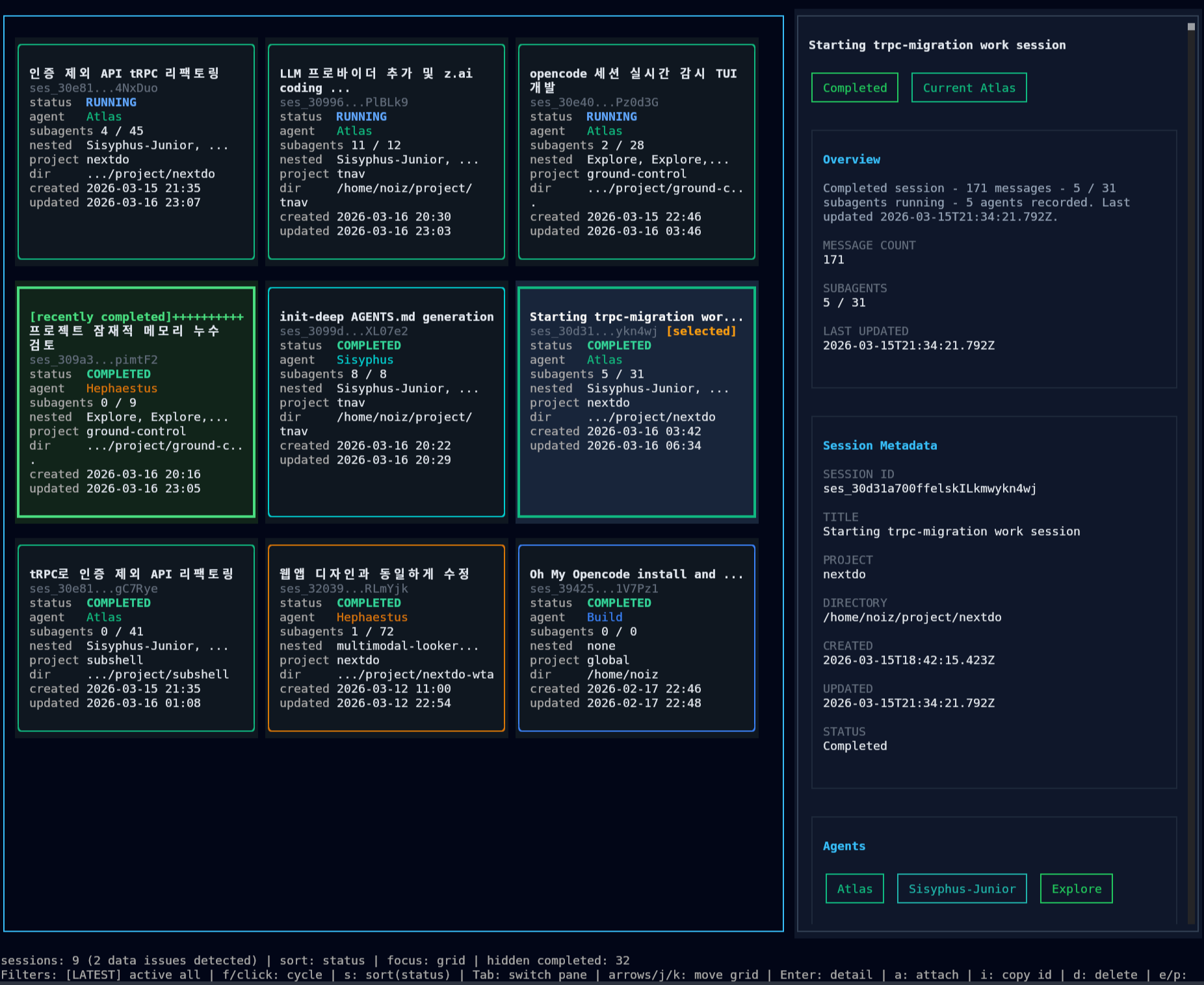
gctrl is a terminal TUI for monitoring OpenCode, Codex, Claude Code, Pi, and omp sessions in real time. It presents session status, active agents, subagent activity, richer source metadata, and recent updates in one card-based interface, while also supporting source-native session deletion flows where the upstream CLI exposes them and conservative local cleanup for file-backed sources.
Quick Start
Make sure these are available before running gctrl:
- Node.js 24 or later
- OpenCode, Codex, Claude Code, Pi, and/or omp installed on the same machine
~/.local/share/opencode/opencode.dbexists for OpenCode monitoring~/.codex/state_*.sqliteand~/.codex/sessions/exist for Codex monitoring~/.claude/projects/and/or~/.claude/sessions/exist for Claude Code monitoring~/.pi/agent/sessions/exists for Pi monitoring~/.omp/agent/sessions/exists for omp monitoring
Run with npx
npx gctrl
Overview
- Displays OpenCode, Codex, Claude Code, Pi, and omp sessions in a live terminal list
- Refreshes automatically every 2 seconds
- Shows status, source, project label, session ID, update time, and richer source metadata
- Supports source-aware actions, copy ID, refresh, and keyboard navigation
Usage
After launch, use these shortcuts to navigate and control the monitor:
| Key | Action |
|---|---|
h / j / k / l / ← / ↑ / ↓ / → |
Move selection in the session grid |
j / k / ↑ / ↓ (detail focus) |
Scroll session detail |
Tab |
Switch focus between grid and detail pane (when sideview is enabled) |
Enter |
Open the selected session detail view |
e / p |
Toggle sideview layout |
f |
Cycle session filter mode (active → recent → busy → all) |
s |
Cycle sort mode (status → update → create) |
c |
Open hierarchy view |
t |
Open hierarchy directly in timeline view |
a |
Attach to the selected session |
i |
Copy the selected session ID |
K |
Stop active child sessions when supported (detail/sideview mode only) |
d |
Request delete for the selected session |
y / n |
Confirm or cancel delete prompt |
r |
Refresh immediately |
Esc / q |
Cancel prompt, close current view, or quit from the main view |
Ctrl+C |
Quit immediately |
Stop Child Sessions (K)
Available in detail or sideview mode. Press K (Shift+K) to gracefully stop all active (non-completed, non-failed) child sessions of the selected session.
Codex, Claude Code, Pi, and omp sessions support attach/inspect/copy/hierarchy/delete flows. Child-abort is supported for OpenCode and Codex sessions. Codex attach uses codex resume <session-id>, Claude Code attach uses claude --resume <session-id>, Pi attach uses pi --session <session-id> for roots and the exact session JSONL path for child artifacts, and omp attach uses omp --resume <session-jsonl-path> when the JSONL path is known, falling back to the session ID only when no path is available. Attach falls back to the current monitor directory if the original session directory no longer exists. Claude Code subagent attach resolves back to the root session because the upstream CLI resumes root conversations by ID.
The stop flow works in two stages:
- Graceful stop: sends a "stop" message to each child session via
opencode run --session <id>, which triggers normal completion (finish: "stop"). - Delete fallback: if graceful stop fails for any child, a per-item confirmation dialog appears where you can choose to delete (
y), skip (n), or cancel all (Esc/q).
Session Filter Modes (f)
active: non-completed sessions, plus externally attached completed sessions. Directory-count fallback is applied as non-complete first, and only remaining slots can surface latest completed sessions.recent: everything visible inactive, plus (1) the globally latest completed session and (2) each project's latest updated session.busy: non-completed sessions only.all: all sessions.
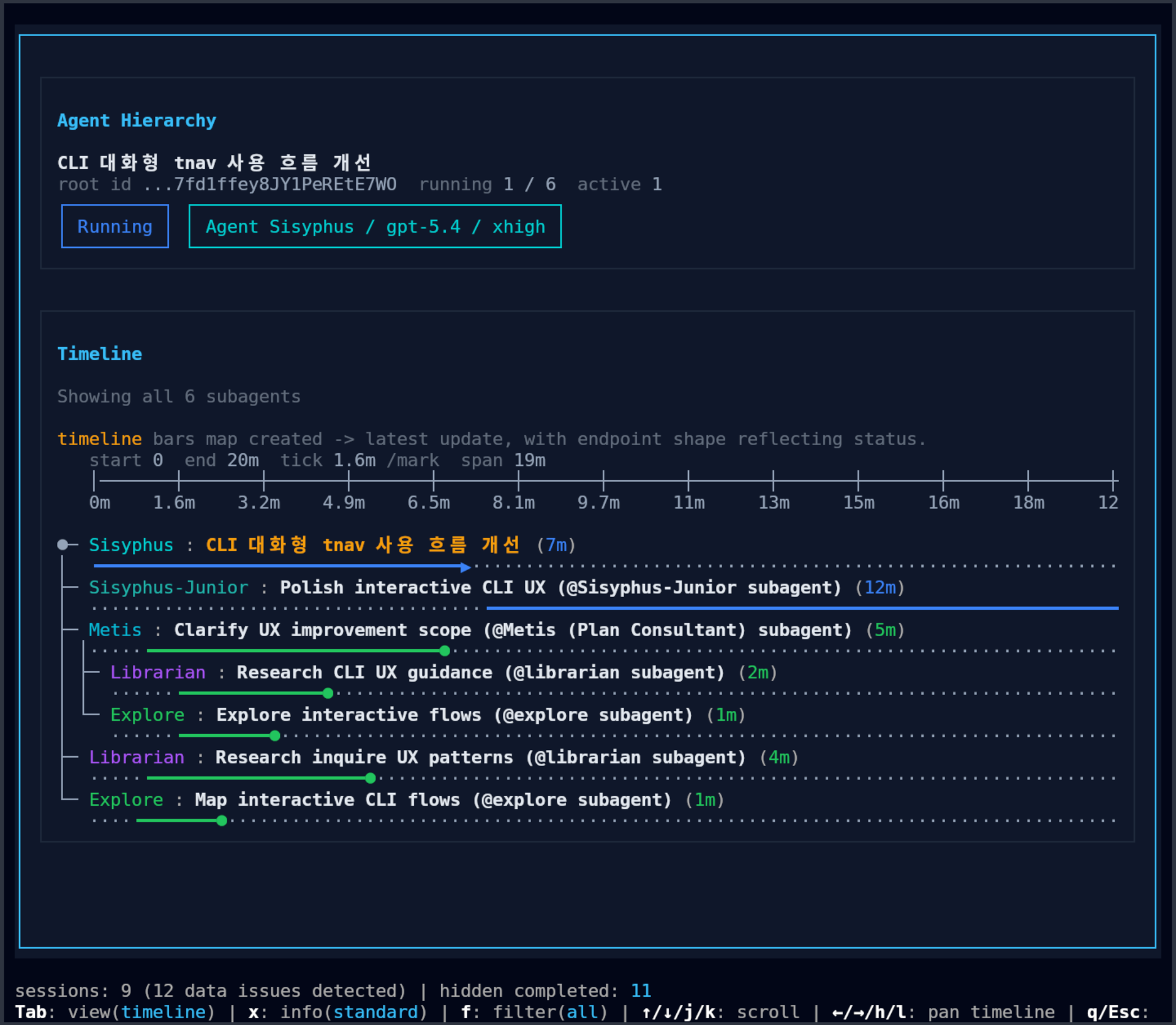
Hierarchy View (c)
Press c on a selected session to open the agent hierarchy view, or press t to open it directly in timeline mode. This shows the session's subagent tree with status, timing, and metadata.
| Key | Action |
|---|---|
Tab |
Cycle view mode (tree / timeline) |
x |
Cycle info mode (standard / detailed) |
f |
Cycle filter mode (latest / busy / all) |
← / → / h / l |
Pan timeline (timeline mode only) |
j / k / Up / Down |
Scroll |
Esc / q |
Close hierarchy view |
Requirements
- Node.js 24+ is required for built-in
node:sqlite. - The native TUI renderer uses a koffi-based FFI adapter (no manual flags needed).
- The monitor reads OpenCode session data from
~/.local/share/opencode/opencode.db. - The monitor reads Codex thread state from the newest
~/.codex/state_*.sqlitefile and enriches it with~/.codex/sessions/**/*.jsonl. - The monitor reads Claude Code session state from
~/.claude/sessions/*.jsonand enriches it with~/.claude/projects/**/*.jsonl. - The monitor reads Pi JSONL sessions from
~/.pi/agent/sessions/**/*.jsonl. - The monitor reads omp JSONL sessions from
~/.omp/agent/sessions/**/*.jsonl. - Override the OpenCode database path with
GCTRL_DB_PATH=/custom/path/opencode.db. - Override Codex paths with
GCTRL_CODEX_STATE_DB_PATH=/custom/path/state.sqlite,GCTRL_CODEX_SESSIONS_DIR=/custom/path/sessions,GCTRL_CODEX_ARCHIVED_SESSIONS_DIR=/custom/path/archived_sessions, andGCTRL_CODEX_SESSION_INDEX_PATH=/custom/path/session_index.jsonl. - Override Claude Code paths with
GCTRL_CLAUDE_PROJECTS_DIR=/custom/path/projectsandGCTRL_CLAUDE_SESSIONS_DIR=/custom/path/sessions. - Override Pi sessions with
GCTRL_PI_SESSIONS_DIR=/custom/path/sessions;PI_CODING_AGENT_SESSION_DIRandPI_CODING_AGENT_DIRare also honored. - Override omp sessions with
GCTRL_OMP_SESSIONS_DIR=/custom/path/sessions;PI_CODING_AGENT_DIR,PI_CONFIG_DIR, and XDG omp candidates are also honored. - OpenCode attach/delete/child-abort actions use the
opencodeCLI. - Codex attach/delete/child-abort actions use the local
codexCLI and app-server protocol. - Claude Code attach actions use the local
claudeCLI. - Pi attach actions use the local
piCLI; Pi delete removes the selected JSONL session and any loaded descendant JSONL sessions. - omp attach actions use the local
ompCLI; omp delete removes the selected JSONL session, loaded descendant JSONL sessions, and sibling artifact directories, but not shared blob storage. - Codex delete uses the local
codex app-serverarchive flow plus cleanup of archived rollout files and local index/state entries. - Claude Code delete intentionally refuses live sessions, then removes matching
projects/,file-history/,session-env/,tasks/, and stalesessions/*.jsonartifacts from local.claude/storage. This follows the official.claudestorage guidance: Claude Code does not expose a delete subcommand, but its local session data can be removed directly. - Non-interactive mode (missing TTY stdin/stdout) prints a tab-separated snapshot and exits.
Local Development
pnpm install
pnpm dev
Useful scripts:
pnpm start
pnpm dev
pnpm build
pnpm typecheck
pnpm lint
pnpm check
pnpm test
Project Structure
bin/          CLI wrapper
src/db/       OpenCode + Codex + Claude Code + Pi/omp data adapters
src/ui/       TUI components
src/config/   color and agent configuration
src/lib/      status detection logic
dist/         compiled output
Session Status Detection
OpenCode status is derived from the latest message in the OpenCode SQLite database. The detection pipeline reads the most recent message row per session, parses its JSON data column, and applies status detectors in priority order. Codex status is mapped conservatively from thread/task events plus thread_spawn_edges, Claude Code status is mapped from local session registries plus JSONL conversation logs and subagent transcripts, and Pi/omp status is mapped conservatively from JSONL message/model/thinking events. Richer raw detail is surfaced separately in the UI.
Status Priority
| Priority | Status | Condition |
|---|---|---|
| 1 | failed |
finish === "error" |
| 2 | waiting |
Question tool is running AND no user response yet (see Waiting Detection below) |
| 3 | completed |
finish === "stop" OR time.completed is a finite number |
| 4 | running |
Not failed, not waiting, not completed |
| 5 | unknown |
Message data is null, empty, or failed JSON parsing |
Finish Values
The finish field on the latest message indicates how the session step ended:
finish |
time.completed |
Detected Status | Display Label |
|---|---|---|---|
stop |
— | completed |
Completed |
tool-calls |
absent | running |
Running |
error |
— | failed |
Failed |
other |
present | completed |
Completed (other) |
length |
present | completed |
Completed (length) |
unknown |
present | completed |
Completed (unknown) |
| undefined | absent | running |
Running |
| no message | — | unknown |
Unknown |
When finish is "other", "length", or "unknown", the status label appends the reason in parentheses — e.g. Completed (other), Completed (length).
Waiting Detection
A session is waiting when the question tool is active and awaiting user input. This uses a secondary signal from the part table:
- Find the latest
partrow withtype === "tool"andtool === "question"wherestate.status === "running" - Compare its timestamp against the latest user message time
- If the question tool time is newer →
waiting(overridesrunning)
Waiting never overrides failed or completed.
Display Override: AWAITING SUBAGENT
A completed root session that has running child sessions displays as AWAITING SUBAGENT instead of Completed. This reflects that the parent is technically done but work continues in subagents. The effective status becomes running for filtering and sorting purposes.
Hierarchy Filter: Latest Mode
In the hierarchy view's "latest" filter mode, subagent sessions are filtered as follows:
- Active subagents (pending/running/waiting) are always shown
- AWAITING SUBAGENT subagents (completed with active children) are always shown
- Terminal subagents (completed/failed/unknown with no active children) — only the most recently updated one is shown
License
MIT
Supervised by NoizBuster, Written by OpenCode