

Aura Code — Autonomous Coding Agent
I don't try. I verify.


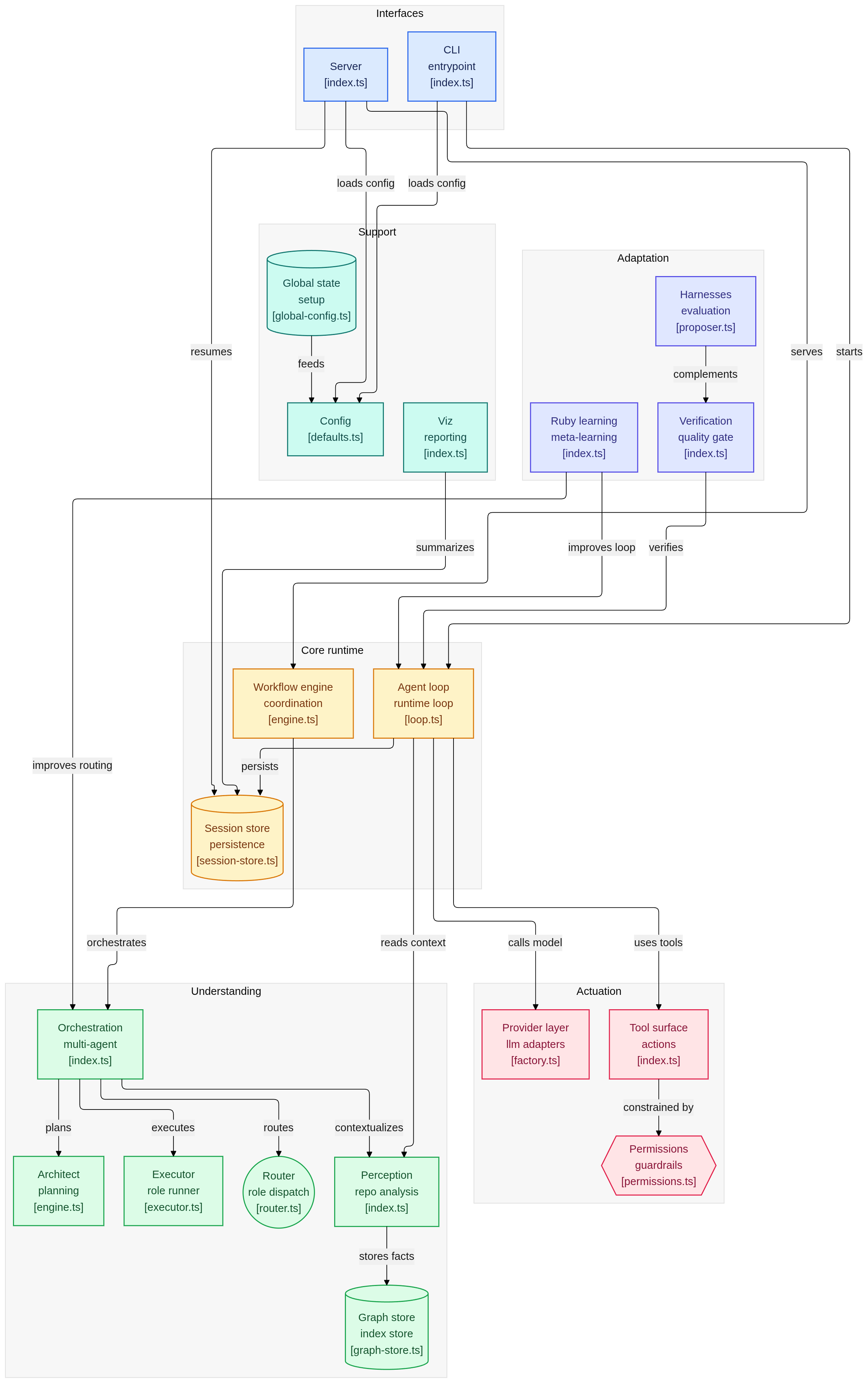
View full architecture documentation →

CLI demo — help, models, and version overview
What is Aura Code?
Designed and brought to life by Dušan Milosavljević using opencode.
Built by agents, for agents — AI-assisted engineering workflows with multiple AI agents contributing to design, implementation, testing, and verification.
Model-agnostic: works with Claude, GPT, Gemini, MiMo, and any OpenAI-compatible endpoint.
Written in TypeScript — not related to the Ruby programming language.
Built on the Praktess framework — from Ancient Greek: she who acts and executes.
Quick Start
npm install -g aura-code
aura 'your task here'
Set at least one API key before running:
export ANTHROPIC_API_KEY="sk-ant-..."   # Claude
export OPENAI_API_KEY="sk-..."          # GPT
export GOOGLE_API_KEY="..."             # Gemini
export XIAOMI_API_KEY="tp-..."          # MiMo
# Local — no API key needed:
# ollama pull qwen2.5-coder:1.5b
What Aura Does
- Reads your codebase — files, structure, dependencies
- Plans a strategy — decides what to change and how
- Executes — writes code, runs commands, makes edits
- Verifies — runs tests, checks file integrity, confirms changes
- Reports — summarizes what was done and what passed
Modes
| Mode | What it does |
|---|---|
normal |
Single-agent loop: read → plan → execute → verify |
orchestrate |
Multi-agent: Researcher → Coder → Reviewer |
architect |
High-level design and planning before implementation |
verify |
Post-task checks with automatic retry on failure |
analyze |
Scan session history for failure patterns |
aura 'fix the bug'                                      # normal
aura --orchestrate 'add error handling to all endpoints' # orchestrate
aura --architect 'design the new auth system'            # architect
aura --verify --test-command "npm test" 'fix the tests'  # verify
aura --analyze                                           # analyze
Providers
| Provider | Models |
|---|---|
| Claude (Anthropic) | Opus, Sonnet, Haiku |
| GPT (OpenAI) | gpt-4o, gpt-4o-mini |
| Gemini (Google) | gemini-2.5-pro, gemini-2.5-flash |
| MiMo (Xiaomi) | mimo-v2.5-pro, mimo-v2.5 |
| DeepSeek (OpenRouter) | deepseek-v4-pro, deepseek-v4-flash:free |
| Ollama (Local) | Any local model — no API key needed |
Any OpenAI-compatible endpoint also works via openrouter/<model>.
Testing
npm install
npm run build      # compiles TypeScript, zero errors expected
npm test           # runs the full suite (vitest)
For local development:
npm run test:watch     # re-runs tests on file changes
npm run test:coverage  # generates a coverage report
The suite currently runs 1000+ tests across 60+ files, covering the agent loop, all provider integrations, the tool registry, safety/permissions, the orchestration and self-improvement layers, and the dashboard generator.
Contributions should keep npm run build and npm test clean before
opening a pull request.
Known Limitations
Self-improvement routing (RubyAlternator) is implemented but inactive. Episode recording and competence scoring both work and are visible in the dashboard's Learning tab, but the routing logic that would actually use competence scores to pick models isn't wired into the main agent loop yet. Today, model selection doesn't change based on what Aura has learned.
Provider behavior varies by model. Tool-calling support, context window handling, and error message quality differ across providers — some of this is normalized (see CHANGELOG for cross-provider config fixes), but not all of it. If a model behaves unexpectedly with tools, check whether the provider documents function-calling support before assuming it's a bug in Aura.
Large refactors still need verification.
--verifyand--test-commandcatch regressions Aura's own changes introduce, but they don't replace review for changes spanning many files or with subtle behavioral intent.Conversation compaction is new. Long sessions now auto-summarize older turns to stay within context limits; this is recently added and still being hardened against edge cases in unusual tool-call sequences.
Stats
| Metric | Value |
|---|---|
| Tests | 1205+ passing, 0 failures |
| Version | v0.6.2 |
| Language | TypeScript (strict) |
| License | MIT |
Repository
GitHub: https://github.com/milodule3-debug/aura-code (Repo renamed from milodule3-debug/rubyness — existing clone URLs redirect automatically)
Links
Built by Lean Progress IQ