
agenticow — Git for Agent Memory: Copy-On-Write vector branching (83× faster, 3000× smaller snapshots)
Branch a base vector memory in ~0.5 ms / 162 bytes — independent of base size. Exact read-through queries (parent ∪ edits, child wins). Built for embedded multi-agent memory.




Website / Demo → · npm · Benchmarks · Acceptance proof
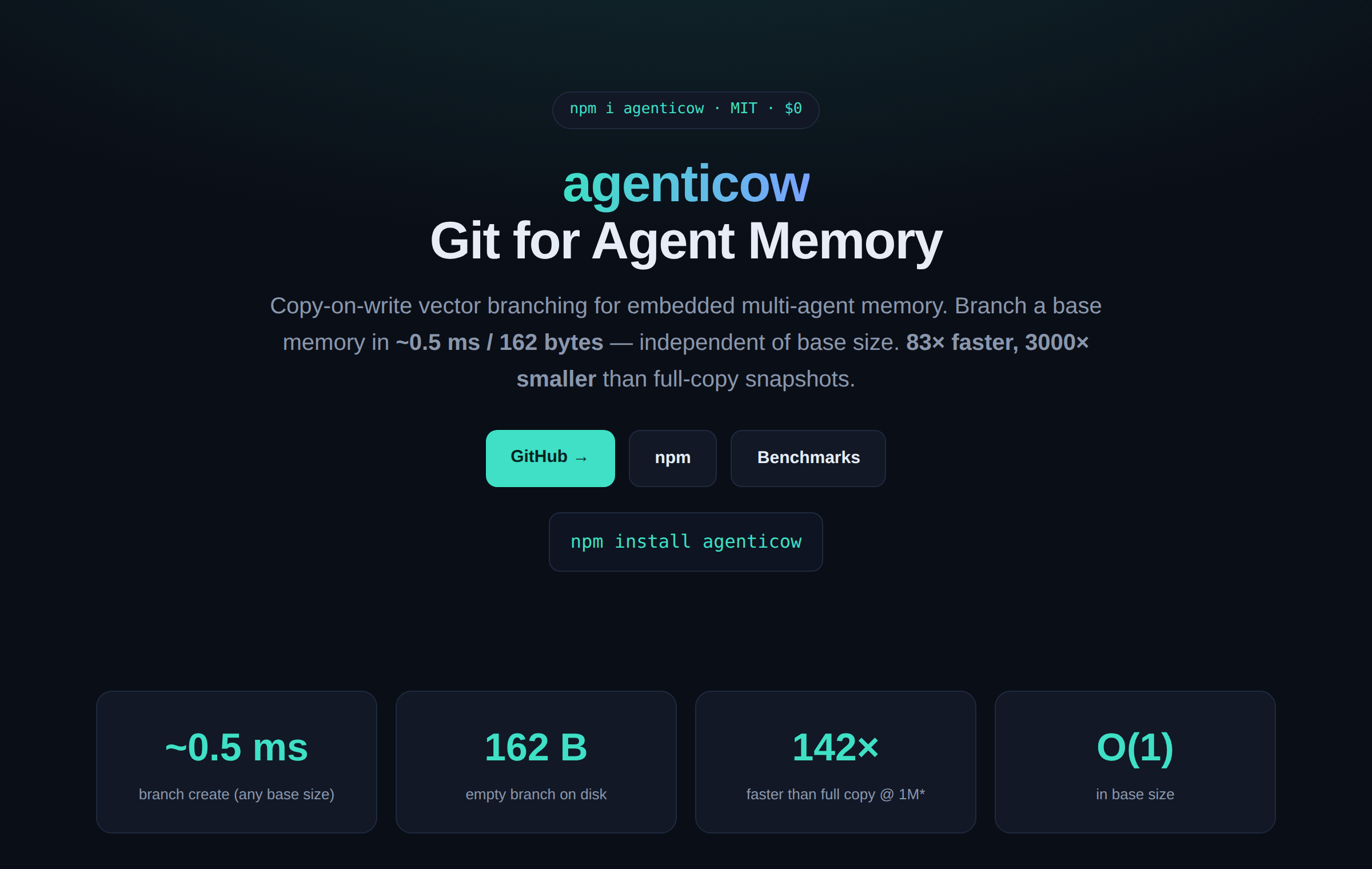
agenticow turns memory from a static database into a branchable runtime primitive for agents.
Every other vector store makes you full-copy the index to snapshot, fork, or checkpoint it. agenticow branches it — copy-on-write, like Git. Creating a branch costs ~0.5 ms and 162 bytes whether the base holds 10,000 or 1,000,000 vectors. Query a branch and you transparently see parent ∪ your edits, with the child winning on id collisions and deletes honored.
npm install agenticowWhy
Agents need memory that branches: a per-user personalization layer, a sandbox to test a risky ingest, a checkpoint before a tool call, a thousand parallel experiments off one shared base. With a normal vector DB each of those is a full copy of the whole index. At 1M vectors that is 496 MB and 67 ms — every time. agenticow makes it 162 bytes and 0.47 ms, flat.
Three things it makes cheap
| Use case | What it replaces | Cost with agenticow |
|---|---|---|
| Parallel agents share one base memory | N full copies of the index | N × 162 B, N × 0.5 ms |
| Roll back a poisoned / hallucinated branch | re-ingest + re-index from backup | drop the branch, ~0.5 ms |
| Zero-cost checkpointing before risky steps | periodic full snapshots | 162 B + edits-since per checkpoint |
Quick start
import { open } from 'agenticow';

// open or create a base memory
const base = open('memory.rvf', { dimension: 1536 });
base.ingest([{ id: 1, vector: embedding }, /* ... */]);

// branch it for a parallel agent — ~0.5 ms / 162 B, any base size
const agent = base.branch('agent-a');
agent.ingest([{ id: 9001, vector: newMemory }]);     // isolated from the base

// exact read-through: sees base + its own edits, child wins on id collision
const hits = agent.query(queryVector, 10);
// -> [{ id, distance, branch }, ...]  (tombstone-masked, reranked)

// NEW in 0.2.0 — native ANN ACROSS the branch (single Rust dual-graph query):
const fast = base.fork('agent-b', null, { nativeAnn: true });
fast.ingest([{ id: 9002, vector: newMemory }]);
fast.query(queryVector, 10);    // parent ∪ edits via native HNSW, recall@10 ≈ 1.0
fast.nativeAnn;                  // true on linux-x64; false (exact fallback) elsewhere

// checkpoint + roll back a poisoned branch
const ckpt = agent.checkpoint('clean');
agent.ingest([{ id: 666, vector: poison }]);
agent.rollback(ckpt.id);                              // poison gone, clean memory intact
CLI
agenticow init   mem.rvf --dim 128
agenticow ingest mem.rvf --n 5000
agenticow branch mem.rvf --as user-42        # cheap per-user personalization
agenticow query  mem.rvf.user-42.rvf --k 10  # top-K read-through (masked, reranked)
agenticow diff   mem.rvf.user-42.rvf         # added / overridden / tombstoned ids
agenticow demo                               # scripted end-to-end walkthrough
agenticow bench                              # branch-create benchmark
agenticow acceptance # the 1,000-branch proof| Verb | Use case |
|---|---|
branch |
per-user / per-repo / per-account personalization off one shared base — personalization without memory explosion |
checkpoint / rollback |
per-task checkpointing; quarantine a bad/hallucinated ingest and instantly revert |
diff / promote |
Git-style memory workflow: agent branch → test → reviewed → production |
query |
top-K read-through with tombstone masking + exact rerank |
fork (API) |
fan out many branches off a static base (1,000 per-user branches in one process) |
A worked script lives in examples/parallel-agents.mjs: fork N branches from a base, ingest + tombstone per branch, query each, roll one back.
Applications
Concrete ways to use COW agent memory — each with a runnable script in
examples/. Framing is honest: practical = PROVEN (bench +
acceptance), platform = DEMONSTRATED + benchmarked, exotic = PoC mechanics
(cognition out of scope). See the claim ladder.
Personalization — one base, a branch per user (practical)
Give every user/account/tenant their own memory branch off a shared base. Private edits stay isolated; storage is delta-only (KB/user, not a full copy).
const base = open('kb.rvf', { dimension: 1536 });
const userMem = base.fork(`user-${userId}`);
userMem.ingest([{ id, vector }]);          // private to this user
userMem.query(q, 10);                       // reads through to the shared base
→ examples/personalization.mjs · parallel-agents.mjs
Rollback / quarantine — discard a poisoned branch (practical)
An agent ingests hallucinated or adversarial memories into a sandbox branch. Detect it, drop the branch — the base is instantly clean, no re-index.
const sandbox = base.fork('untrusted');
sandbox.ingest(unvettedVectors);
// ...detect bad content...
sandbox.close();                            // discard → base never saw it
→ examples/rollback-quarantine.mjs
Checkpointing — crash recovery without replay (practical)
Checkpoint memory before each risky step (162 B each). On failure, roll back to the last good checkpoint in ~0.5 ms — earlier steps are not replayed.
const ck = mem.checkpoint('step-30');
// ...step 31 crashes...
mem.rollback(ck.id); // resume from step 30Git-style memory workflow — branch → diff → promote (practical)
Treat memory like code: branch a feature, review the change with diff(), and
promote() the vetted delta into production.
const feature = prod.branch('feature');
feature.ingest(newFacts);
feature.diff();                              // { added, overridden, deleted }
feature.promote(prod); // merge into productionPromotion pipeline — agent → sandbox → review → prod (platform — DEMONSTRATED)
A "memory DevOps" pipeline: an agent proposes memories in a sandbox branch, a
review gate scores them, and only a passing branch is promoted. A rejected branch
is discarded and never reaches base — with a lineage audit (parent/label/timestamp)
at each step.
→ examples/promotion-pipeline.mjs
A/B testing at scale — score variants, promote the winner (platform — DEMONSTRATED)
Fork N variant branches off one base, score each, and promote only the winner. Benchmarked at 128 variants (fork 1.3 ms/variant, score 0.15 ms/variant, 0.84 KB/variant).
const variants = ids.map((i) => base.fork(`variant-${i}`));
// ...score each...
variants[best].promote(base);               // keep the winner, drop the rest free
→ examples/ab-branches.mjs · ab-at-scale.mjs
Compliance, lineage & right-to-erasure (platform — DEMONSTRATED)
lineage() gives an auditable parent/label/timestamp trail for every mutation
("why does the agent know X?"). Per-user data lives in its own branch layer, so
dropping that layer surgically erases exactly that user's data (GDPR-style).
→ examples/compliance-lineage.mjs
Edge / local-first agents — embedded, no server (strategic)
agenticow runs in-process over a single .rvf file — no DB server, no network.
Thousands of cheap branches fit on-device for offline/edge multi-agent memory.
Cognitive ensembles, evolution & simulated orgs (exotic — PoC mechanics)
PoCs that demonstrate the branching mechanics of advanced patterns — NOT that the branches are intelligent (the judge/fitness is a scoring function, cognition is out of scope):
- Parallel selves — an ensemble of personas off one base, a judge picks + promotes the winner →
examples/parallel-selves.mjs - Darwin-on-memory — a population evolves over generations; storage stays delta-sized →
examples/memory-evolution.mjs - Simulated org — departmental branches with cross-branch contradiction detection before rollout →
examples/simulated-org.mjs
Agent marketplaces & shared base memories (exotic — vision, not shipped)
A published base memory that many agents branch from, contributing deltas back — a "memory package registry". The branch/promote primitives exist today; the distribution, trust, and merge-policy layer is roadmap, not shipped.
MetaHarness usage
agenticow is the memory plane of the @metaharness/*
agent-harness ecosystem. It pairs with @metaharness/jujutsu
(v0.1.0), which wraps agentic-jujutsu
(a Rust+NAPI Jujutsu jj op-log with QuantumDAG coordination, ReasoningBank
trajectories, and ML-DSA signing) — the code/op plane.
The dual-state bridge (ADR-202). A coding agent that explores must branch and
roll back two planes: the code/ops it did and the memory it learned.
Used separately they drift (revert code but keep poisoned memory; promote a
memory delta whose ops were never merged). @metaharness/jujutsu's
DualStateBridge ties them 1:1 — one agent ⇒ one op branch + one memory branch —
mapping four lifecycle verbs onto agenticow:
| Verb | code/op plane (agentic-jujutsu) | memory plane (agenticow) |
|---|---|---|
| spawn | jj bookmark create + start trajectory |
fork() off the base + checkpoint('spawn') |
| learn | finalize trajectory + read op-sequence | embed ops → ingest() into the branch |
| revert | jj undo |
rollback() to the spawn checkpoint |
| merge | jj squash ops into base |
promote() the winning delta into the base |
Install alongside (both planes are optional peer deps — the bridge runs degraded/mock-backed if one is absent, per the ADR-150 removable-augmentation principle):
npm install @metaharness/jujutsu agenticow agentic-jujutsuimport { open } from 'agenticow';
// @metaharness/jujutsu wires these two planes behind DualStateBridge:
const base = open('reasoning-bank.rvf', { dimension: 1536 });
const agentMem = base.fork('agent-007'); // memory branch (spawn)
agentMem.checkpoint('spawn');
agentMem.ingest(embeddedTrajectory); // learn
// if the trajectory scores poorly:
agentMem.rollback(/* spawn checkpoint id */); // revert — code revert via `jj undo`
// if it wins:
agentMem.promote(base); // merge — ops via `jj squash`Honest status (ADR-202): spawn / learn / revert / merge are wired
end-to-end with both real native planes. Cross-branch ANN query is now
shipped — agenticow 0.2.x adds native dual-graph ANN across the COW boundary
(fork({ nativeAnn: true }), RuVector PR #617/#618,
recall@10 ≈ 1.0 on linux-x64; exact read-through fallback elsewhere). The bridge
adapter can swap from the exact-read-through port to the native ANN port with no
interface change.
How copy-on-write for vectors works
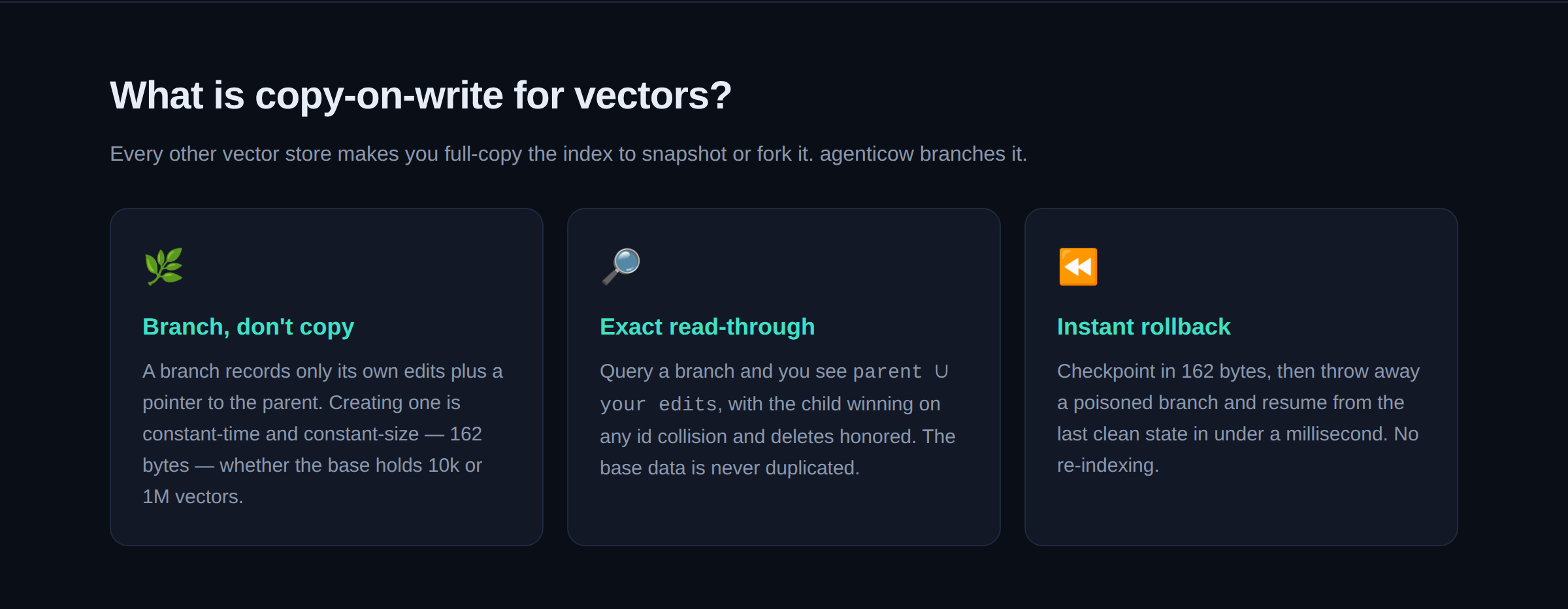
A branch records only its own edits plus a pointer to its parent. Creating one is constant-time and constant-size — 162 bytes — independent of base size. A query walks the lineage chain (child → … → base), merges each store's results, lets the child win on any id collision, masks anything the branch tombstoned, and re-ranks by exact distance.
Benchmarks
Reproduced on an AMD Ryzen 9 9950X (32 threads), Node v22, dim 128, cosine, median of 11 runs. Run it yourself: npx agenticow bench.
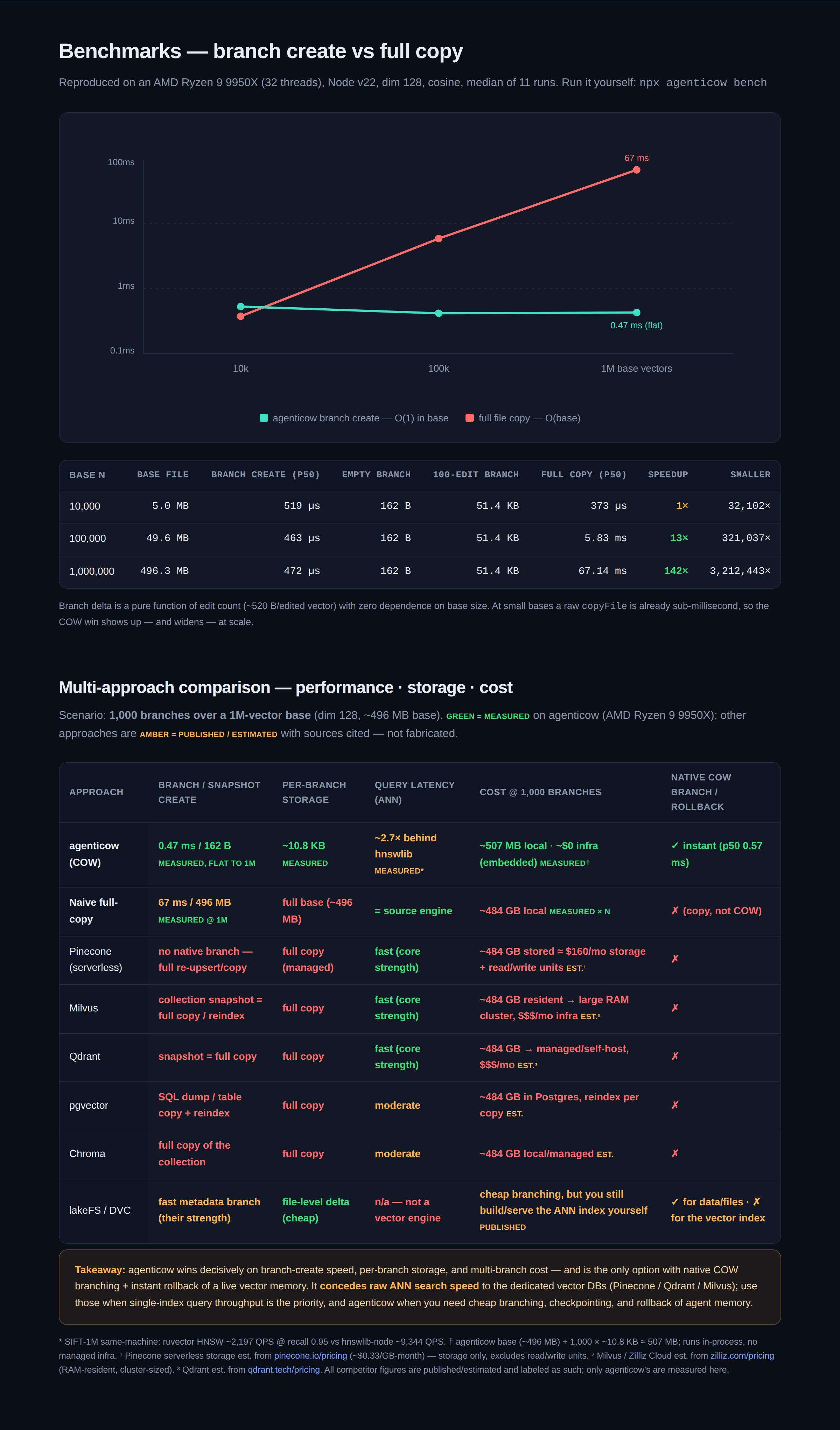
| Base N | Base file | Branch create (p50) | Empty branch | 100-edit branch | Full copy (p50) | Speedup | Smaller |
|---|---|---|---|---|---|---|---|
| 10,000 | 5.0 MB | 519 µs | 162 B | 51.4 KB | 373 µs | 1× | 32,102× |
| 100,000 | 49.6 MB | 463 µs | 162 B | 51.4 KB | 5.83 ms | 13× | 321,037× |
| 1,000,000 | 496.3 MB | 472 µs | 162 B | 51.4 KB | 67.14 ms | 142× | 3,212,443× |
Branch delta is a pure function of edit count (~520 B / edited vector) with zero dependence on base size. At a 10k base a raw copyFile is already sub-millisecond, so the COW win shows up — and widens — at scale. The original RVF COW proof reports the conservative 83× / 3000× figures (0.78 ms vs 64.7 ms; 162 B vs 496 MB); the reproduction above is consistent and, on this machine, better on speed.
Acceptance: the 1,000-branch proof
npm run acceptance (or agenticow acceptance) runs the full spec and reports real numbers. Latest run, AMD Ryzen 9 9950X, base = 20,000 vectors, dim 128:
| Measurement | Result |
|---|---|
| Branches forked | 1,000 off one base (median 0.487 ms/fork, 4.5 s total) |
| Top-10 correctness | recall@10 = 100%, exact-order match 100% (120 sampled queries vs brute-force ground truth) |
| Tombstone masking | PASS — 0 tombstoned ids leaked into results |
| Rollback latency | p50 = 0.571 ms (min 0.48 / max 1.01), ~constant |
| Storage vs delta | 1,000 branches = 10.5 MB total (10.8 KB/branch) vs 9.69 GB for 1,000 full copies → 943× less disk; total branch storage is 1.06× the base (grows with delta, not base) |
| Verdict | PASS ✓ |
The acceptance test builds a brute-force ground truth (base ∪ branch-inserts − tombstones, reranked by cosine distance) and asserts the read-through top-K matches it. If a 1,000-branch fork ever hits a real fd/memory/time limit, the test reports the max that worked plus the scaling curve — the 1,000 is not faked. Results are written to bench/acceptance-results.json.
How it compares
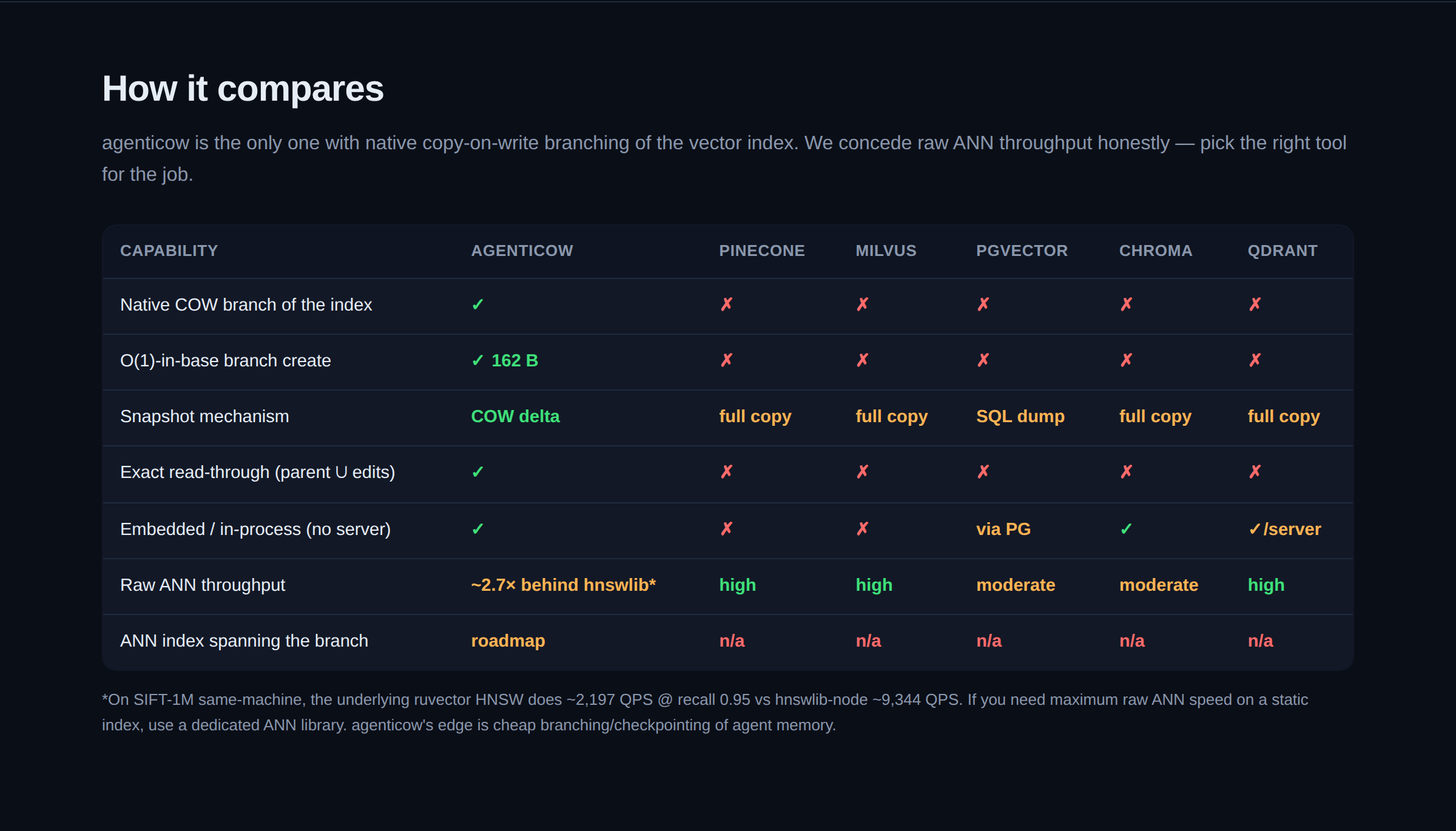
| Capability | agenticow | Pinecone | Milvus | pgvector | Chroma | Qdrant |
|---|---|---|---|---|---|---|
| Native COW branch of the index | ||||||
| O(1)-in-base branch create | 162 B | |||||
| Snapshot mechanism | COW delta | full copy | full copy | SQL dump | full copy | full copy |
| Exact read-through (parent ∪ edits) | ||||||
| Embedded / in-process (no server) | via PG | /server | ||||
| Raw ANN throughput | ~2.7× behind hnswlib* | high | high | moderate | moderate | high |
| ANN search spanning the branch | shipped (recall@10 ≈ 1.0, linux-x64**) | n/a | n/a | n/a | n/a | n/a |
* Honest concession. On SIFT-1M, same machine, the underlying ruvector HNSW does ~2,197 QPS @ recall 0.95 vs hnswlib-node ~9,344 QPS — roughly 2.7× slower for raw ANN. If you need maximum raw similarity-search speed on a static index, use a dedicated ANN library. agenticow's edge is cheap branching, checkpointing and rollback of agent memory — which none of the above have.
** Native ANN-across-branch (fork({ nativeAnn: true })) ships for linux-x64-gnu today; other platforms degrade gracefully to exact read-through. The raw-ANN-speed concession above still applies to the underlying engine.
Performance · storage · cost at scale
Scenario: 1,000 branches over a 1M-vector base (dim 128, ~496 MB base). agenticow figures are measured on an AMD Ryzen 9 9950X; competitor figures are published / estimated (sources below) and labeled as such — not fabricated.
| Approach | Branch / snapshot create | Per-branch storage | Query latency (ANN) | Cost @ 1,000 branches | Native COW / rollback |
|---|---|---|---|---|---|
| agenticow (COW) | 0.47 ms / 162 B (measured, flat to 1M) | ~10.8 KB (measured) | ~2.7× behind hnswlib (measured*) | instant (p50 0.57 ms) | |
| Naive full-copy | 67 ms / 496 MB (measured @1M) | full base (~496 MB) | = source engine | ~484 GB local (measured ×N) | |
| Pinecone (serverless) | no native branch — full re-upsert | full copy (managed) | fast (core strength) | ~484 GB ≈ $160/mo storage + units (est.¹) | |
| Milvus | snapshot = full copy / reindex | full copy | fast (core strength) | ~484 GB resident → large cluster, $$$/mo (est.²) | |
| Qdrant | snapshot = full copy | full copy | fast (core strength) | ~484 GB → managed/self-host, $$$/mo (est.³) | |
| pgvector | SQL dump + reindex | full copy | moderate | ~484 GB in Postgres (est.) | |
| Chroma | full collection copy | full copy | moderate | ~484 GB local/managed (est.) | |
| lakeFS / DVC | fast metadata branch (their strength) | file-level delta (cheap) | n/a — not a vector engine | cheap branching, but you still build/serve the ANN index yourself (published) | data/files · vector index |
Takeaway: agenticow wins on branch-create speed, per-branch storage, and multi-branch cost, and is the only option with native COW branching + instant rollback of a live vector memory. It concedes raw ANN search speed to the dedicated vector DBs — use those when single-index query throughput is the priority, and agenticow when you need cheap branching, checkpointing, and rollback of agent memory.
* SIFT-1M same-machine (above). † base ~496 MB + 1,000 × 10.8 KB ≈ 507 MB, in-process. ¹ est. from pinecone.io/pricing ($0.33/GB-mo storage, excl. read/write units). ² est. from zilliz.com/pricing. ³ est. from qdrant.tech/pricing. Competitor figures are published/estimated; only agenticow's are measured.
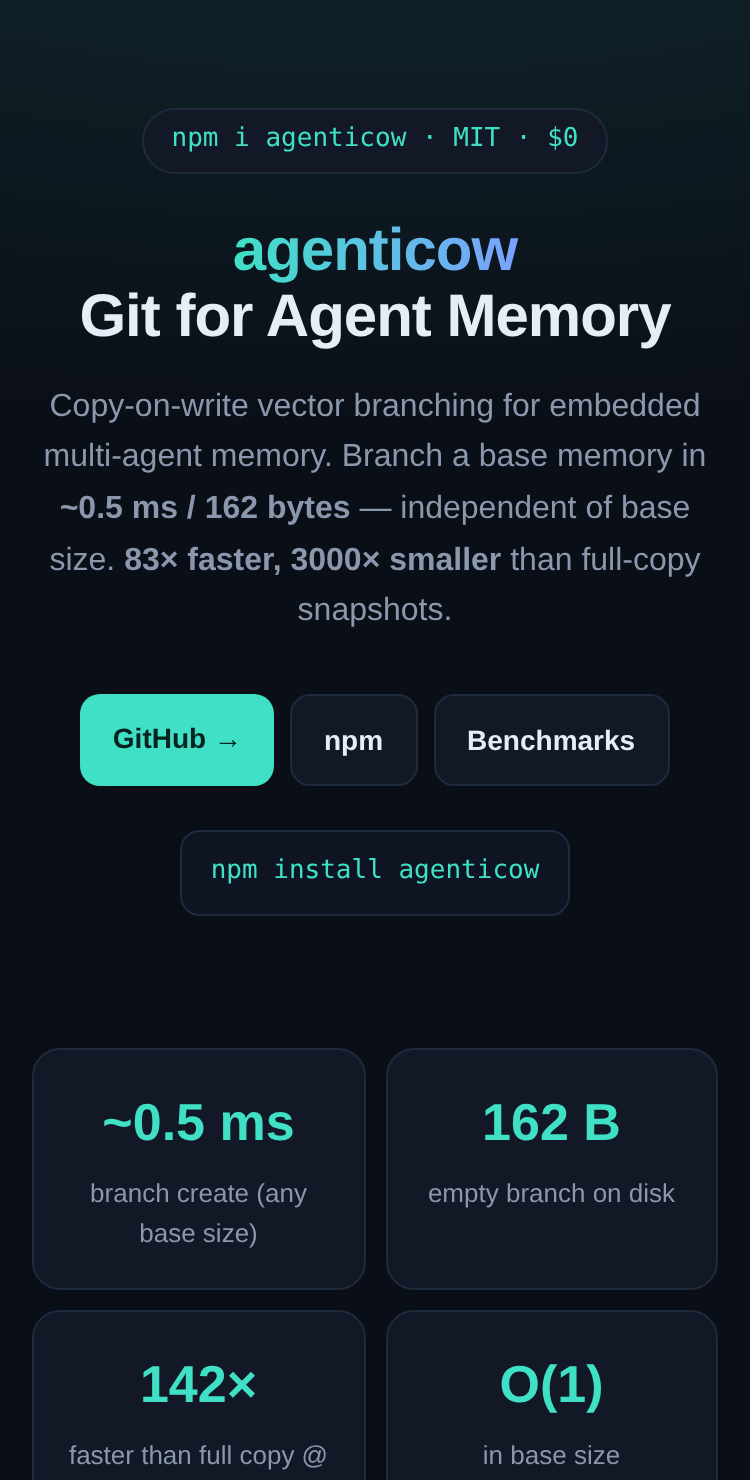
The live site is mobile-friendly (responsive layout, horizontally-scrollable tables):
Honest scope
agenticow ships, and proves, exactly this:
- COW branch creation — base-size-independent, 162 B / ~0.5 ms (the 83× / 3000× headline). Proven by
npm run bench. - Exact read-through queries — point lookup / flat-scan merge returning
parent ∪ edits, child wins on collisions, deletes honored. Proven bynpm run acceptance(recall@10 = 100%, masking PASS). - Native ANN search ACROSS the COW boundary — now shipped (was roadmap).
fork(label, file, { nativeAnn: true })creates a realRvfDatabase.branch()whosequery()runs a single Rust dual-graph HNSW merge over parent ∪ child (RuVector PR #617/#618). Verified recall@10 ≈ 1.0 (0.999) here — 5,000-vector base ∪ 200 edits, dim 128, default cosine — vs a brute-force ground truth. Platform caveat: the native binary ships for linux-x64-gnu today; darwin / win / linux-arm64 are pending a CI cross-compile and degrade gracefully to the exact read-through path (identical correctness, JS merge —mem.nativeAnnreadsfalse).
Still honest about the rest:
- We still concede raw single-index ANN throughput to dedicated vector DBs (~2.7× behind hnswlib, see comparison).
- The exotic applications (agent marketplaces, etc.) remain vision/roadmap, clearly labeled.
Note on cosine. rvf-node does not persist the cosine metric across a file reopen, and its native COW dual-graph query is accurate for L2, not for the cosine metric directly. agenticow therefore drives the underlying engine with L2 over L2-normalized vectors when you ask for cosine (the default) — L2 order equals cosine order on unit vectors. This makes both the exact read-through and the native ANN path correct for cosine, and is why results survive
save()/load(). (Reopening a cosine store via plainopen()reports the engine metricl2; pass{ metric: 'cosine' }or usesave()/load()to preserve the user-facing metric.)
Claim ladder
Where agenticow is today, and where it's going — labeled honestly, each tier backed by runnable, executed code.
| Tier | Claim | Status |
|---|---|---|
| Practical | Cheap, base-independent branch / checkpoint / rollback of vector memory (162 B / ~0.5 ms); exact read-through with tombstone masking. | PROVEN — npm run bench + npm run acceptance (1,000 branches, recall@10 = 100%) |
| Platform | A "memory DevOps" layer — promotion pipelines, compliance/lineage & right-to-erasure, A/B at scale for multi-agent infrastructure. | DEMONSTRATED + benchmarked — examples/{promotion-pipeline,compliance-lineage,ab-at-scale}.mjs; ops bench npm run bench:ladder: fork 464 µs, score 133 µs, promote 897 µs, contradiction-check ~1M pairs/s, 0.84 KB/branch |
| Exotic | A substrate for evolving / competing cognitive branches — parallel "selves", Darwin-on-memory, simulated orgs with contradiction detection. | PoC-feasible — examples/{parallel-selves,memory-evolution,simulated-org}.mjs demonstrate the branching mechanics (shared base, isolated deltas, judge + promote, contradiction scan). The cognitive quality of a branch is out of scope — the judge/fitness is a scoring function, not validated AI cognition. |
Run the tier examples: npm run examples (all) · npm run examples:platform · npm run examples:exotic.
API
import { open, AgenticMemory } from 'agenticow';

const mem = open(path, { dimension, metric?, track? });  // metric default "cosine"

mem.ingest([{ id, vector }])           // or ingest(Float32Array, ids) for speed
mem.query(vector, k?, { efSearch?, overscan? })  // exact read-through, child wins
mem.delete(ids)                        // COW tombstone (hides ancestor ids)

mem.branch(label?)                     // isolated COW fork (auto-isolates the parent)
mem.fork(label?)                       // lightweight fork off a static/read-only base
mem.checkpoint(label?)                 // freeze a restore point, keep working
mem.rollback(checkpointId?)            // discard edits since a checkpoint

mem.diff()                             // { added, overridden, deleted }
mem.promote(target)                    // replay this branch's edits into target

mem.lineage(); mem.status();           // introspection
mem.save(manifestPath); AgenticMemory.load(manifestPath)  // persist / reopen the chain
mem.close();branch()auto-isolates: it freezes the current state and re-points the parent to a fresh child, so neither side sees the other's later writes — safe when you keep writing to both.fork()is onederive()with no re-pointing — ideal for fanning out many branches off a base you won't mutate again (the 1,000-branch case).
Install & requirements
npm install agenticow- Node ≥ 18, ESM. Current: agenticow@0.2.1 on @ruvector/rvf-node@0.2.0.
- Depends on
@ruvector/rvf-node(prebuilt native binding for linux-x64/arm64, darwin-x64/arm64, win32-x64). - Native ANN across the branch (
fork({ nativeAnn: true })) requires the native COW binary, which ships for linux-x64-gnu today. On other platforms it degrades gracefully to the exact read-through path — same correctness,mem.nativeAnn === false. The exact path (the default) works on every platform.
Keywords
agent memory · vector database branching · copy-on-write · COW vector store · multi-agent memory · embedded vector DB · memory checkpointing · vector branching · git for vectors · AI agent memory · LLM memory · vector snapshot · rollback · checkpoint