
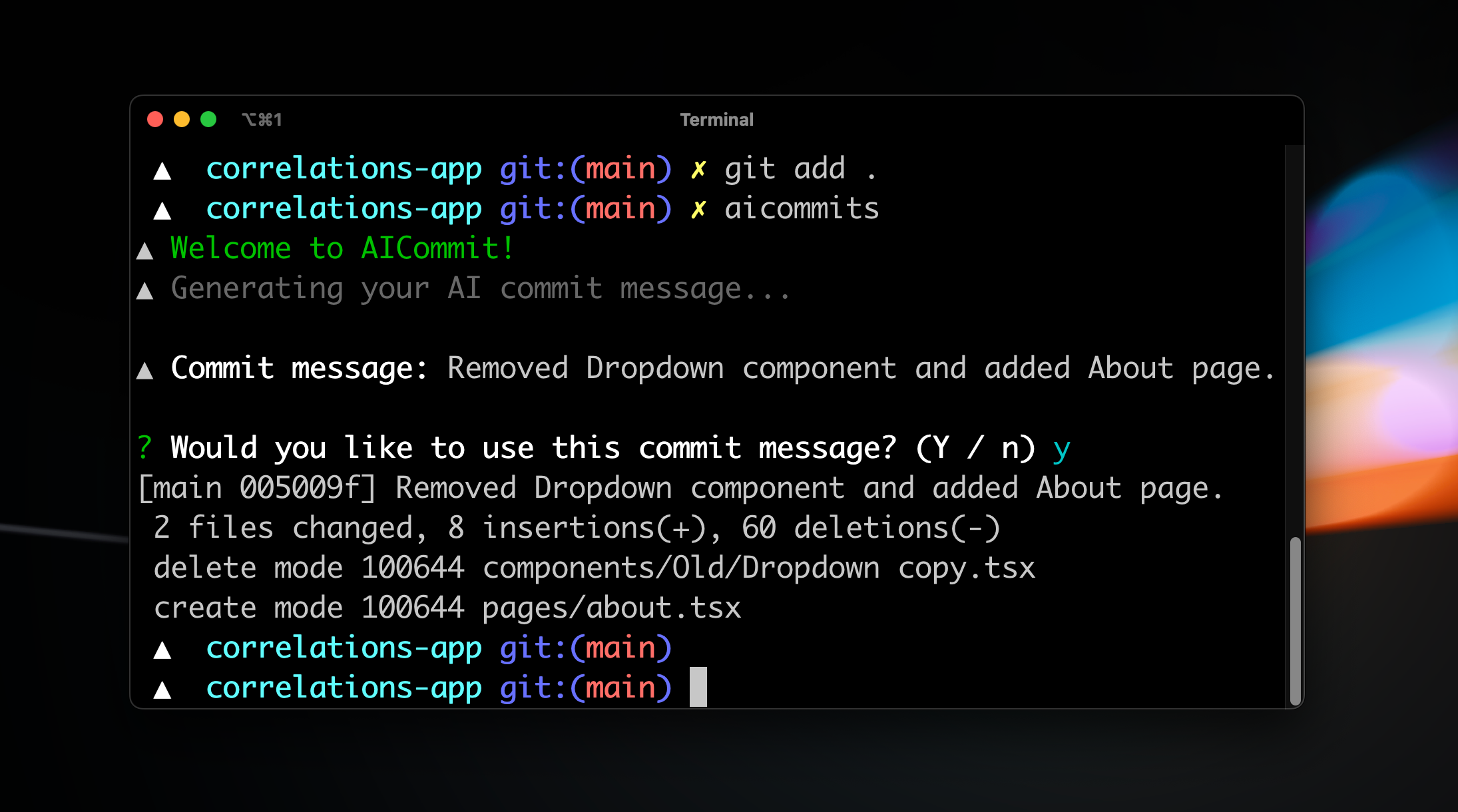
AI Commits
A CLI that writes your git commit messages for you with AI. Never write a commit message again.

Setup
The minimum supported version of Node.js is the latest v14. Check your Node.js version with
node --version.
Install aicommits:
npm install -g @sugarmo/aicommitsRetrieve your API key from your API provider
Note: If you haven't already, you'll have to create an account and set up billing.
Set the key so aicommits can use it:
aicommits config set api-key=<your token>This will create
~/.aicommits/config.toml.
Upgrading
Check the installed version with:
aicommits --versionIf it's not the latest version, run:
npm update -g @sugarmo/aicommitsUsage
CLI mode
You can call aicommits directly to generate a commit message for your staged changes:
git add <files...>
aicommits
aicommits passes down unknown flags to git commit, so you can pass in commit flags.
For example, you can stage all changes in tracked files with as you commit:
aicommits --all # or -aGenerate multiple recommendations
Sometimes the recommended commit message isn't the best so you want it to generate a few to pick from. You can generate multiple commit messages at once by passing in the --generate <i> flag, where 'i' is the number of generated messages:
aicommits --generate <i> # or -g <i>Warning: this uses more tokens, meaning it costs more.
Non-interactive environments (Git GUI, external clients, CI)
If your environment does not provide an interactive TTY, skip prompts explicitly:
aicommits --confirm # or -y / --yesPrint without committing
To generate a commit message and print it without creating a Git commit:
aicommits --print # or --no-commitThis uses the first generated message and exits before running git commit.
Steer the first AI draft
Use --steer to give the model one-off context about what the commit is meant to accomplish before it writes the first draft:
aicommits --steer "Fix the page failing to load"The steer text helps the model describe the intent of the change instead of only restating the diff. The diff remains the source of truth if the steer text conflicts with the code.
Guide output with Markdown
Commit message style is now controlled by a Markdown file instead of individual formatting flags.
By default, aicommits reads ~/.aicommits/message.md. The file is created automatically on first use.
aicommitsTo use a different Markdown file for one run:
aicommits --message-file release-message.mdThe default file includes editable instructions for language, title format, body rules, and style. If you were previously using settings like type, details, instructions, or conventional-*, upgrade once and those values will be migrated into message.md automatically.
Post-process the AI response
You can run an executable after the model responds and before the message is shown or committed.
aicommits --post-response-script rewrite-message.shThe script receives the raw AI message on stdin and must write the final message to stdout.
Git hook
You can also integrate aicommits with Git via the prepare-commit-msg hook. This lets you use Git like you normally would, and edit the commit message before committing.
Install
In the Git repository you want to install the hook in:
aicommits hook installUninstall
In the Git repository you want to uninstall the hook from:
aicommits hook uninstallUsage
Stage your files and commit:
git add <files...>
git commit # Only generates a message when it's not passed in
If you ever want to write your own message instead of generating one, you can simply pass one in:
git commit -m "My message"Aicommits will generate the commit message for you and pass it back to Git. Git will open it with the configured editor for you to review/edit it.
Save and close the editor to commit!
Configuration
Runtime configuration is read from ~/.aicommits/config.toml (and CLI flags). Environment variables are not used as config inputs.
The file format is TOML.
Reading a configuration value
To retrieve a configuration option, use the command:
aicommits config get <key>For example, to retrieve the API key, you can use:
aicommits config get api-keyYou can also retrieve multiple configuration options at once by separating them with spaces:
aicommits config get api-key generateSetting a configuration value
To set a configuration option, use the command:
aicommits config set <key>=<value>For example, to set the API key, you can use:
aicommits config set api-key=<your-api-key>You can also set multiple configuration options at once by separating them with spaces, like
aicommits config set api-key=<your-api-key> generate=3Options
api-key
Required
API key for your configured API provider.
You can also keep the secret outside config.toml and reference an environment variable instead:
api-key = "env:OPENAI_API_KEY"${OPENAI_API_KEY} is also supported if you prefer shell-style syntax.
base-url
Required
Base URL used for API requests.
aicommits config set base-url=https://api.openai.com/v1profile
Default: empty
Selects a named profile from the profiles table in config.toml.
When a profile is selected, profile values override top-level values.
aicommits config set profile=openaiExample:
api-key = "top-level-key"
model = "gpt-4o-mini"
profile = "openai"

[profiles.openai]
model = "gpt-5.2-codex"
base-url = "https://api.example.com/v1"
generate
Default: 1
The number of commit messages to generate to pick from.
Note, this will use more tokens as it generates more results.
proxy
Set a HTTP/HTTPS proxy to use for requests.
To clear the proxy option, you can use the command (note the empty value after the equals sign):
aicommits config set proxy=model
Default: gpt-3.5-turbo
The model to use for generation.
api-mode
Default: responses
Controls which API primitive aicommits uses.
responses: default and recommended for new setupschat: legacy compatibility mode
aicommits config set api-mode=chattimeout
The timeout for network requests to the API in milliseconds.
Default: 10000 (10 seconds)
aicommits config set timeout=20000 # 20scontext-window
Default: 0 (auto/default compaction budget)
Set model context size (tokens) so diff compaction can scale to your provider/model window and reduce truncation on large commits.
When set, aicommits reserves part of the window for system prompt and output, then compacts the diff to fit the remaining budget.
aicommits config set context-window=32768You can also use K / M suffixes:
aicommits config set context-window=32K
aicommits config set context-window=1M
Use 0 to switch back to auto mode:
aicommits config set context-window=0include-submodule-commits
Default: false
When a staged or uncommitted change updates a Git submodule pointer, include that submodule's commit log in the diff sent to the model. This gives the model the submodule commit subjects as context instead of only seeing the old and new submodule SHAs.
aicommits config set include-submodule-commits=truemessage-path
Default: message.md
Relative paths resolve from ~/.aicommits/. The referenced Markdown file controls how commit messages should be written.
aicommits config set message-path=release-message.mdpost-response-script
Default: empty
Relative paths resolve from ~/.aicommits/. The executable receives the AI response on stdin and must write the final commit message to stdout.
aicommits config set post-response-script=rewrite-message.shshow-reasoning
Default: false
By default, aicommits shows normal analyzing progress.
If the API emits reasoning content, it switches to elapsed thinking time (for example The AI (gpt-5.4) is thinking for 1m 12s).
Enable this option to print full streamed model reasoning (debug mode):
aicommits config set show-reasoning=trueOr enable for a single run:
aicommits --show-reasoningreasoning-effort
Default: unset
Controls the model reasoning effort requested by aicommits.
none,low,medium,high,xhigh: request an explicit reasoning level
This is the supported way to configure reasoning effort.
aicommits maps it to reasoning.effort for Responses API requests and reasoning_effort for Chat requests.
aicommits config set reasoning-effort=lowOr for a single run:
aicommits --reasoning-effort highrequest-options
Default: empty
Raw JSON object merged into the selected API request body.
Use this for provider-specific fields that do not already have a dedicated aicommits option.
For reasoning effort, prefer reasoning-effort instead of passing reasoning or reasoning_effort manually.
Internal fields model, messages, instructions, input, and stream are controlled by aicommits and cannot be overridden.
aicommits config set request-options='{"thinking":{"type":"disabled"}}'How it works
This CLI tool runs git diff to grab your latest code changes, sends them to your configured API provider using the Responses API by default, then returns the generated commit message. You can switch back to Chat Completions with api-mode=chat.
Video coming soon where I rebuild it from scratch to show you how to easily build your own CLI tools powered by AI.
Maintainers
- Steven Mok: @sugarmo
Contributing
If you want to help fix a bug or implement a feature in Issues, checkout the Contribution Guide to learn how to setup and test the project.