
anamnesis
AI coding agent config lifecycle manager. Keep your AI coding agents from forgetting what your project is.



The problem
Every time you open a project with Claude Code (or Codex, Cursor, …), your agent starts blank. No project conventions. No ontology. No context.
So you write an AGENTS.md, ontology files, hooks, slash commands,
skills, and handoff notes — and then you do it again for the next
project. And the project after that.
Switching tools has the same failure mode. A project configured for Claude Code does not automatically give Codex or Cursor the same current context, ontology, handoff state, and operating rules.
The word anamnesis (ἀνάμνησις) means "not forgetting" in Greek — the literal opposite of amnesia. This tool prevents agent amnesia.
What anamnesis does
- Installs always-loaded context: project memory, ontology slices, handoff instructions, operational reminders, skills, hooks, and command intent.
- Keeps context portable across agents: the same Agentfile and fragment capabilities render to Claude Code, Codex, and Cursor so the next agent can continue without a bespoke "read these files first" prompt.
- Detects stack-specific concerns from your project files
(
prisma/schema.prisma,@nestjs/coreinpackage.json,uv.lock, …) and overlays the matching fragment. - Re-syncs as the library evolves, preserving your edits — files you've authored or modified are never overwritten without consent.
- Promotes your project-local hooks/skills back into the library so other projects benefit.
It is not an application scaffolder (no package.json, no source code generation). It manages the small markdown/yaml/shell ecosystem your AI agent reads, and can optionally scaffold project-facing docs when explicitly requested.
Quickstart
Install (npm — scoped package, the unscoped anamnesis name is taken
by an unrelated project):
npm install -g @mcprotein/anamnesis…or run on demand without global install:
npx @mcprotein/anamnesis init --dry-runEither way, the CLI is invoked as anamnesis.
Building from source instead (during development or for forks):
git clone https://github.com/MCprotein/anamnesis
cd anamnesis
npm install
npm run build       # produces cli/dist/
npm link            # makes `anamnesis` available globally
Then in any project:
cd /path/to/your/project
anamnesis init --dry-run                 # preview what would happen
anamnesis init --allow-exec-adapters     # actually install
anamnesis init --tools all --allow-exec-adapters
# install Claude Code, Codex, and Cursor surfaces on first init
anamnesis init --scaffold-docs --allow-exec-adapters
# also create missing README.md and docs/PROJECT-CONTEXT.md starter docs
anamnesis init --enhance-docs --allow-exec-adapters
# add managed context-review sections to existing README/docs
When an AI agent runs the setup for you, it should use the
anamnesis-init skill first. That skill asks a single multiple-choice
question about README/docs handling, then maps the answer to no docs flag,
--scaffold-docs, or --enhance-docs.
What gets created:
your-project/
├── Agentfile                                    # selected fragments + tool list
├── AGENTS.md                                    # canonical context (existing prose preserved)
├── CLAUDE.md                                    # Claude Code entrypoint pointing to AGENTS.md
├── .anamnesis/
│   ├── manifest.json                            # region/file hashes for drift detection
│   ├── ontology/{base,<fragment>}.yaml          # static ontology slices
│   ├── ontology/*.bootstrap.yaml                # deterministic project facts
│   └── handoff/active.md                        # current work index when handoff is used
├── .claude/                                     # Claude Code adapter output
│   ├── hooks/{inject-ontology, remind-uncommitted, …}.sh
│   ├── commands/load-context.md
│   └── skills/load-context/SKILL.md
├── .cursor/rules/                               # Cursor adapter output when enabled
├── .codex/{config.toml,hooks.json}              # Codex native hooks when enabled
├── .anamnesis/codex-native-hooks/               # Codex native hook wrappers
└── .anamnesis/codex-hooks/                      # Codex git-hook bridge when enabled
AGENTS.md is additive — anamnesis appends regions inside <!-- anamnesis:region ... --> anchors. Anything outside the anchors is yours.
README.md and docs/PROJECT-CONTEXT.md are opt-in. Use
--scaffold-docs to create missing starter docs, or --enhance-docs to add
managed context-review regions to existing docs without replacing your prose.
Lifecycle
anamnesis init      # first-time setup; writes install evidence
anamnesis update    # library updates + drift detection (dry-run by default; --apply writes evidence)
anamnesis update --bump-pinned  # explicitly move pinned fragments to current
anamnesis status    # fragments, drift, ontology gaps, continuity, evidence, context diagnostic summary
anamnesis doctor    # read-only installation integrity + continuity/ontology/context diagnostics
anamnesis doctor --append  # record doctor diagnostics as runtime evidence
anamnesis hooks summary --append  # summarize hook logs and record runtime evidence
anamnesis migrate agentfile  # schema migration readiness check; --apply writes after backup
anamnesis dogfood check --append  # score and record self-check continuity evidence
anamnesis context index --write  # build a local source-pointer index
anamnesis context query "managed region"  # retrieve exact context pointers
anamnesis context diagnose  # report handoff, ontology, docs/bootstrap, and evidence consistency issues
anamnesis context resume  # print a compact resume bundle with size metrics
anamnesis benchmark report --append  # record deterministic context-quality scorecard evidence
anamnesis benchmark compare --baseline before.json --after after.json --append  # record before/after deltas
anamnesis benchmark gallery --write  # refresh evidence-backed README claim candidates
anamnesis benchmark gallery --validate  # fail when gallery evidence is stale
anamnesis benchmark trace --append  # roll up benchmark trace logs as runtime evidence
anamnesis benchmark task --template  # create a model-dependent task/retrieval benchmark input
anamnesis benchmark task --input task-run.json --append  # record an agent task run separately
anamnesis benchmark task-compare --template  # create a paired full/compact task template
anamnesis benchmark task-compare --full full.json --compact compact.json --append  # compare paired full/compact task runs
anamnesis benchmark task-series --write  # roll up repeated task-compare evidence with graphs
anamnesis benchmark prompt-gate  # decide using scorecard, session-context, and retrieval evidence
anamnesis promote   # lift a project-local file into the library as a reusable fragment
Re-running update on an unchanged project produces only noop results. User edits are surfaced as user-modified and library updates skip them. Backups go to .anamnesis/backups/<timestamp>/; settings.backup_retention keeps the newest N backup directories (0 means unlimited).
Generation boundary
anamnesis separates deterministic CLI generation from agent-assisted semantic generation:
| Generated by | Output | Meaning |
|---|---|---|
CLI (init, update) |
AGENTS.md, static .anamnesis/ontology/*.yaml, adapter surfaces |
Managed context, baseline ontology slices, and tool-specific read surfaces |
Agent (anamnesis-init) |
selected anamnesis init command flags |
Multiple-choice README/docs choice before an agent runs first-time setup for the user |
CLI (ontology bootstrap) |
.anamnesis/ontology/*.bootstrap.yaml |
Regenerable Layer A facts under schema_version: anamnesis.bootstrap.v1 with deterministic generator and facts fields |
Agent (/ontology-enrich) |
.anamnesis/ontology/*.enriched.yaml |
Layer B semantics under schema_version: anamnesis.enriched.v1 with stable IDs, evidence, confidence, append-safe re-runs, supersedes, and open_questions |
Agent (/handoff-prepare) |
.anamnesis/handoff/active.md plus timestamped archives |
Current task state for switching sessions or agents |
CLI commands print this boundary so users can tell whether the current
project state is CLI-generated, agent-enriched, or still missing semantic
handoff/ontology context. status also reports ontology gaps across static
slices, missing or stale deterministic bootstrap facts, semantic enrichment,
and fragments that do not yet have a Layer A introspector; doctor turns
actionable gaps into repair warnings. When Layer A facts are missing or
stale, the guidance continues into /ontology-enrich so the active agent can
draft the semantic .enriched.yaml layer instead of leaving users to write it
by hand.
Layer A is intentionally a baseline, not a promise to model every framework in depth. The CLI extracts facts it can prove from files; Layer B uses the active agent to turn those facts into relationships, flows, intent, invariants, and open questions that future agents can reuse.
Fragment catalog
| id | trigger | capabilities |
|---|---|---|
base |
always (auto-included) | project_memory, ontology, 4× executable_hook, 2× slash_command, 3× skill |
prisma |
@prisma/client in package.json or prisma/schema.prisma |
project_memory, ontology, executable_hook |
k8s |
k8s/ directory |
project_memory, ontology, executable_hook (yaml-lint) |
nestjs |
@nestjs/core in package.json |
project_memory, ontology |
nextjs |
next in package.json |
project_memory, ontology |
fastapi |
fastapi in pyproject.toml |
project_memory, ontology |
python-uv |
uv.lock exists |
project_memory, ontology |
docker-compose |
docker-compose.yml / compose.yaml |
project_memory, ontology |
rails |
Gemfile + config/application.rb |
project_memory, ontology |
django |
django in pyproject.toml or manage.py |
project_memory, ontology |
go |
go.mod exists |
project_memory, ontology |
rust |
Cargo.toml exists |
project_memory, ontology |
sveltekit |
@sveltejs/kit in package.json |
project_memory, ontology |
remix |
@remix-run/node / @remix-run/react in package.json |
project_memory, ontology |
nuxt |
nuxt in package.json |
project_memory, ontology |
Triggers are evaluated by rulebook.md. Add your own fragment with anamnesis promote or by adding a directory under fragments/.
Capability model
Each fragment declares one or more capabilities in fragment.yaml. Capabilities are tool-agnostic; adapters render them onto a specific tool's surface.
| Capability | What it represents | Claude Code | Codex | Cursor |
|---|---|---|---|---|
project_memory |
Always-loaded context | AGENTS.md region + CLAUDE.md entrypoint |
AGENTS.md region |
AGENTS.md region read by Cursor |
ontology |
Structured reference | SessionStart hook injection | Codex native SessionStart wrapper + AGENTS fallback | rules instruction |
executable_hook |
Event-driven automation | .claude/hooks/*.sh |
native wrappers for Codex-supported lifecycle events; AGENTS fallback + optional git hook bridge | rules fallback |
skill |
Reusable procedure | .claude/skills/<n>/SKILL.md |
AGENTS.md section (fallback) | rules (fallback) |
slash_command |
User-invoked command | .claude/commands/<n>.md |
AGENTS.md section (fallback) | rules (fallback) |
The adapters do not promise identical native UI. Claude Code, Codex, and Cursor expose different primitives, so anamnesis targets user-facing parity: project recall, ontology access, handoff continuity, and operational guardrails should survive switching agents.
Detail in docs/ADAPTER-PARITY.md,
docs/AGENT-SWITCHING-GUIDE.md, and
docs/DESIGN.md.
Evidence
anamnesis is dogfooded on itself. Public claims are limited to sanitized fixtures and self-check evidence; private-project validation is kept out of README, packaged docs, and public benchmark artifacts.
Session context benchmark
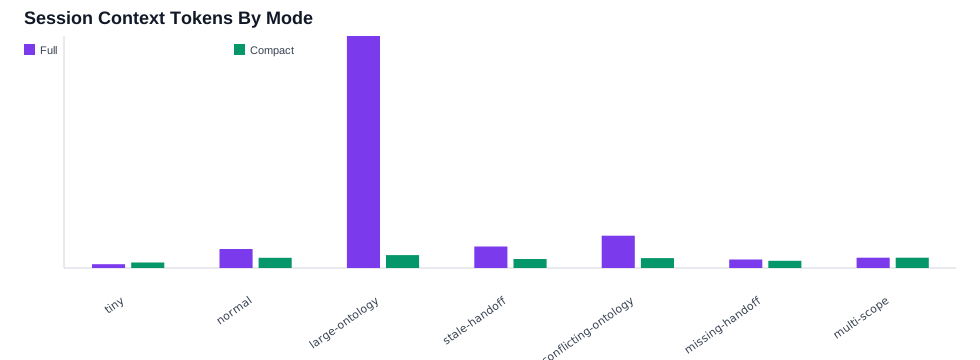
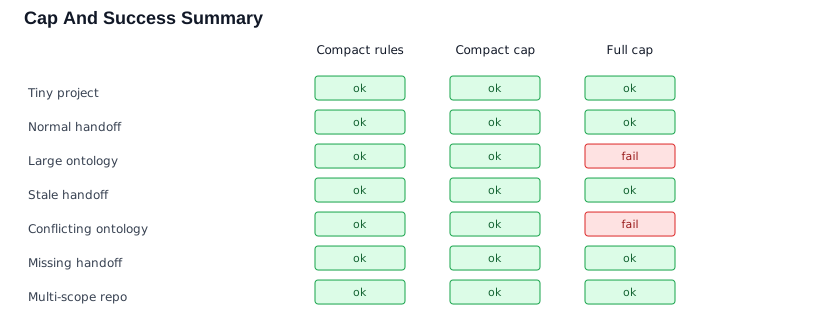
v1.5 changed SessionStart from full file-body injection to compact source pointers plus invariant digests. The deterministic benchmark compares both modes across public-safe fixtures.
Current run:
- Large ontology fixture: compact mode reduced estimated startup tokens by
94%. - Hard-cap outcomes: compact mode exceeded the cap
0times; full mode exceeded it2times. - Required retrieval rules and source pointers were present in
7/7compact fixture runs.
Full generated evidence is in
docs/benchmark-evidence/session-context/.
Current self-check records live in docs/DOGFOOD.md.
Public-safe benchmark boundaries live in
docs/BENCHMARK-GALLERY.md, and broader
ecosystem claims stay intentionally disallowed. The claim ledger is
docs/README-CLAIMS.md.
Model-dependent task diagnostics live separately in
docs/AGENT-TASK-BENCHMARKS.md and are not
used for deterministic README score claims.
Safety
--allow-exec-adaptersflag is required for installs into.claude/{hooks,commands,skills}/. Default is content-only (AGENTS.md regions, ontology slices). This blocks remote-fragment supply-chain risk.- Files on disk that aren't in the manifest are classified as
user-modifiedand never overwritten. This catches both pre-existing files (from before anamnesis adoption) and post-install user edits. updateis dry-run by default. Pass--applyto actually write.- Backups are taken automatically before
update --applymodifies any file.
Roadmap
| Version | Theme | Status |
|---|---|---|
| v0.1 | Claude Code adapter + idempotency model | shipped 2026-04-26 |
| v0.2 | Multi-tool (Codex), monorepo scopes, status, npm publish |
shipped 2026-04-27 |
| v0.3 | Cursor adapter, Codex hook/skill/slash fallback, monorepo init UX, agent handoff MVP | shipped 2026-04-28 |
| v0.4 | Hybrid ontology bootstrap, /ontology-enrich, init auto-bootstrap, continuity polish |
shipped 2026-04-29; 0.4.1 expands framework introspectors; 0.4.2 ships operational polish |
| v0.5 | Dogfood lifecycle validation and agent-switch continuity hardening | shipped 2026-04-30 |
| v0.6 | Repeatable bounded ontology generation plus agent-assisted enrichment | shipped 2026-05-03 |
| v0.7 | Multi-agent UX, lifecycle scale, and benchmark reports | shipped 2026-05-03 |
| v0.8 | Schema, API, migration, and repair workflow stabilization | shipped 2026-05-04 |
| v0.9 | Registry, signing, docs, and public benchmark readiness | shipped 2026-05-04 |
| v1.0 | Stable schema, public API, migration surface, docs, and evidence-backed claims | shipped 2026-05-04 |
| v1.1 | Codex native lifecycle hooks, hook diagnostics, real hook smokes, and runtime evidence | shipped 2026-05-07; latest patch 1.1.1 |
| v1.2 | Numeric benchmark evidence, public scorecards, and runtime evidence expansion | shipped 2026-05-08; latest patch 1.2.1 |
| v1.3 | Fragment dependency resolution and update event hooks | shipped 2026-05-08 |
| v1.4 | Adoption automation and project context bootstrap | shipped 2026-05-11; latest patch 1.4.4 |
| v1.5 | Compact SessionStart defaults and session-context benchmark graphs | shipped 2026-06-19 |
| v1.6 | Repo-local context index/query/resume and contradiction diagnostics | shipped 2026-06-25 |
Detailed plan: docs/ROADMAP.md.
Monorepo application guide: docs/MONOREPO.md.
Documentation
docs/ROADMAP.md— version-by-version plandocs/AGENT-SWITCHING-GUIDE.md— install once, switch agents, and continue work without re-briefingdocs/AGENTFILE-SCHEMA-AUDIT.md— v0.8 audit of Agentfile fields, compatibility fixtures, and v1.0 freeze risksdocs/AGENTFILE-V1-FREEZE.md— v1 Agentfile freeze decisions, reserved fields, and strict parser policydocs/AGENTFILE-MIGRATIONS.md—anamnesis migrate agentfilecommand contractdocs/API.md— v1.0 TypeScript API stability contractdocs/REPAIR.md— repair playbook for existing managed projectsdocs/FRAGMENT-AUTHORING.md— public fragment authoring guide, review checklist, versioning, and compatibility rulesdocs/FRAGMENT-REGISTRY.md— v0.9 registry metadata, discovery, version selection, cache, and trust-boundary designdocs/FRAGMENT-SIGNING.md— v0.9 remote fragment checksum, signature, trust-store, and rejection policydocs/REGISTRY-V1-DECISION.md— v1.0 decision to keep remote registry/signing implementation post-v1.0docs/DOCS-SITE-PLAN.md— v0.9 GitHub-first docs decision, information architecture, and future site triggerdocs/DOCS-V1-AUDIT.md— v1.0 public documentation coverage and known limitation auditdocs/REMOTE-SYNC-STRATEGY.md— v1.0 decision to omit broadsyncand keep registry refresh/update explicitdocs/ADAPTER-PARITY.md— tested capability parity matrix across Claude Code, Codex, and Cursordocs/SWITCHING-SCENARIOS.md— tested 3x3 source/target handoff scenarios across supported agentsdocs/BENCHMARKS.md— deterministic context-quality benchmark reportsdocs/AGENT-TASK-BENCHMARKS.md— model-dependent task benchmark harness and claim boundarydocs/BENCHMARK-GALLERY.md— public-safe benchmark evidence, claim policy, and collection targetsdocs/README-CLAIMS.md— v1.0 evidence-backed README claim ledgerdocs/MONOREPO.md— applying anamnesis to a monorepodocs/ONTOLOGY-BOOTSTRAP.md— two-layer ontology generationdocs/RELEASING.md— npm Trusted Publishing release flowdocs/DESIGN.md— architecture, capability model, idempotencyspecs/agentfile.md—Agentfilev1 schemarulebook.md— auto-detection rules and trigger DSLCONTRIBUTING.md— adding fragments, writing capabilitiesCHANGELOG.md— release notes
License
MIT — see LICENSE.