
KPS: Key Pinned Streams
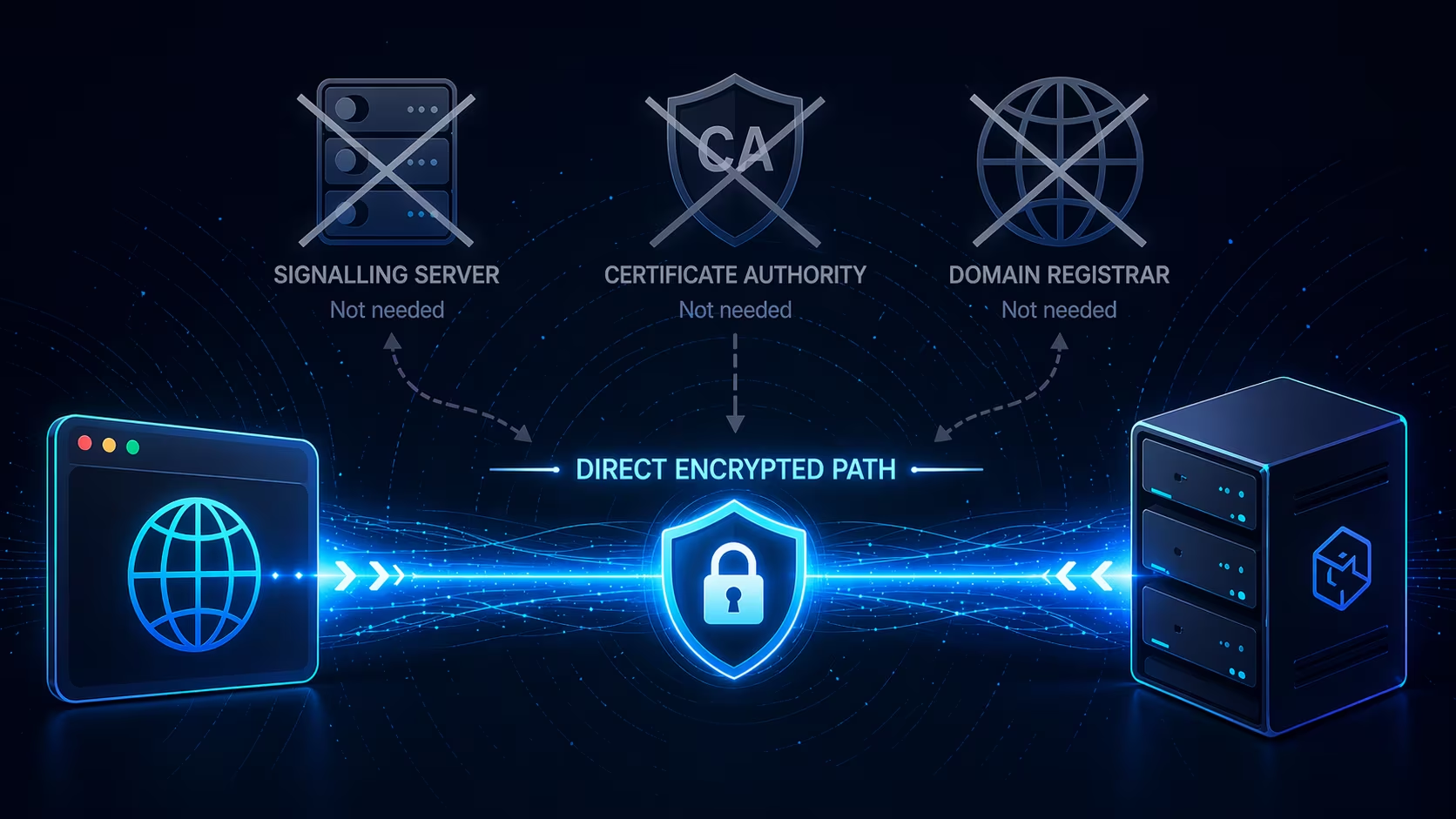
A small library for opening secure, multiplexed byte streams to a peer identified by a cryptographic certificate hash, not by a domain name signed by a certificate authority.
The address you dial is just <ip>:<port>:<certhash>. The certhash pins the
server's self-signed certificate, so as long as the address reaches you intact,
the connection cannot be intercepted. The same address works from the browser
(over WebRTC) and from native code (over QUIC), on one UDP port — the public
API hides which transport a connection uses.
See SPEC.md for the wire protocol and SECURITY.md
for the trust and censorship-resistance model.
What this is for
The browser-to-server channel that the web is built on requires a CA-signed cert for a registered domain — a model that solves authentication by delegating to authorities. KPS gives you the same thing without those dependencies: server identity is its certificate, and clients pin its hash out-of-band (in code, in a config file, in a QR code, however).
WebRTC makes it work from a browser today; QUIC makes it work from native clients (Go, and later Rust/CLI/mobile) against the same listener. One self-signed certificate serves both — it's presented in the WebRTC DTLS handshake and the QUIC TLS 1.3 handshake, and a single certhash pins both.
Inspiration
KPS descends from WebRTC Direct as implemented in libp2p: a DTLS handshake against a self-signed cert whose hash is published out-of-band, with ICE-lite + synthesized SDP so no signaling server is needed. The earlier exploration lives at voltrevo/webrtc-direct-demo. The transport trick is great; the libp2p baggage on top (multistream-select, Noise XX on a separate key, peer store, discovery, varint protobuf framing) pays for properties that aren't needed for "talk securely to a known server" — so KPS strips it down to the pinned-key stream, and adds a native QUIC transport.
What's intentionally not here:
- Peer discovery — KPS clients dial a known address.
- Stream names / protocol negotiation — streams are unnamed; applications route and frame inside the stream bytes.
- A second pinned key beyond the cert — the cert hash is the identity.
- App-level message framing — streams are raw byte streams; the application chooses its own encoding.
What works
Browser, native-Go, and Node clients interoperate with a Go or Node
(@kpstreams/server) listener, end-to-end encrypted. Both transports —
WebRTC (browser) and QUIC (native / Node) — share one UDP port and one
address, with the API hiding which is in use.
- Unnamed, multiplexed byte streams — reliable, ordered, no message
boundaries; QUIC-like lifecycle (
closeWrite→ EOF,cancelRead,resetWrite). Any number of streams per connection, any number of connections per port. - Datagrams — unreliable, unordered, size-limited messages on every connection (QUIC DATAGRAM; a reserved unreliable channel on WebRTC).
- Censorship-resistant handshake — the ICE password is derived from the
certhash (no recomputable fingerprint), the QUIC ALPN is non-identifying, and
the certificate carries no KPS-identifying metadata (see
SECURITY.md).
An interop test matrix exercises all of this: Go tests cover the Go library
(multi-conn, multi-stream, the stream lifecycle, datagrams, connection-close
codes, and both transports on one port simultaneously); a Node node:test suite
drives @kpstreams/quic-client and @kpstreams/server end-to-end and
cross-implementation against the Go server (streams, datagrams, backpressure,
certhash-pinning rejection, abort); and a Playwright-driven Chromium covers the
real browser Go and browser JS-server paths. CI runs the lot.
Layout
libs/js/        TypeScript npm packages (@kpstreams/*): core, webrtc-client, quic-client, server
libs/go/        Go library + cmd/server & cmd/dial CLIs — import "github.com/privacy-ethereum/kps/libs/go"
demos/chat/     Chat + eth-rpc demo (server-go + web) consuming the libraries
tests/interop/  Playwright interop test — a browser dials the Go and JS servers
Quick taste
Go server (echoes each stream's bytes back):
ln, _ := kps.Listen(ctx, ":4242", kps.Options{KeyFile: "kps.key"})
fmt.Println(ln.Address("")) // 192.168.x.y:4242:uEi...

for {
    conn, err := ln.Accept(ctx)
    if err != nil { return }
    go func() {
        for {
            s, err := conn.AcceptStream(ctx)
            if err != nil { return }
            go func() { io.Copy(s, s); s.CloseWrite() }()
        }
    }()
}
Native Go client (QUIC by default):
conn, _ := kps.Dial(ctx, "192.168.x.y:4242:uEi...")
s, _ := conn.OpenStream(ctx)
s.Write([]byte("hello"))
s.CloseWrite()
io.Copy(os.Stdout, s) // "hello"
Browser (WebRTC):
import { dial } from '@kpstreams/webrtc-client'

const conn = await dial('192.168.x.y:4242:uEi...')
const stream = await conn.openStream()

const writer = stream.writable.getWriter()
await writer.write(new TextEncoder().encode('hello'))
await writer.close()

const reader = stream.readable.getReader()
const { value } = await reader.read()
console.log(new TextDecoder().decode(value)) // "hello"
Status
Pre-1.0, but built end-to-end: a monorepo with SPEC.md as the source
of truth, two interoperating transports on one port, unnamed byte streams with a
full lifecycle, mandatory datagrams, a censorship-resistant handshake, and an
interop matrix + CI. Rough edges remain.